

Beyond Lead Generation: How Intent Data Helps Customer Success Drive Retention and Revenue Growth

Beyond Lead Generation: How Intent Data Helps Customer Success Drive Retention and Revenue Growth
Your next revenue opportunity might already be a customer. Discover how intent data can help Customer Success teams identify churn risks, improve customer engagement, and uncover upselling and cross-selling opportunities.
Customer Retention Starts the Moment You Sign a Contract
There's a saying in Customer Success that I particularly like:
As Johnathan Silver said "You start losing a customer the moment you sign them."(1)
It might sound dramatic, but there's a lot of truth behind it.
Customer retention isn't something you start thinking about when a renewal approaches. It begins on day one and requires continuous engagement, value delivery, and an understanding of your customers' evolving needs.
Most Customer Success teams already rely on product usage, customer health scores, quarterly business reviews (QBRs), and regular meetings to understand how their accounts are performing.
But there's another valuable source of customer intelligence that often gets overlooked: intent data from your own website.
We typically associate intent data with B2B lead generation, identifying potential buyers, and helping Sales teams prioritize outreach. But why should those insights stop being useful once a prospect becomes a customer?
1. Using Intent Data to Identify Potential Churn Risks
Your existing customers continue visiting your website long after signing a contract.
They might explore educational content, product documentation, ROI-related articles, or even information about cancellation and contract terms.
These activities can provide additional context about customer engagement and potential concerns.
For example, if an existing account repeatedly visits content related to ROI challenges or cancellation procedures, it might be worth investigating whether they're struggling to achieve the expected value.
This doesn't automatically mean the customer is unhappy or planning to leave. However, combined with declining product adoption, a low health score, or an approaching renewal, it could indicate that proactive engagement is needed.
Intent data shouldn't replace customer health scores or QBRs. It should complement them.
The objective is simple: identify potential problems earlier, reach out at the right moment, and help customers succeed before retention becomes a concern.
2. Identifying Upselling and Cross-Selling Opportunities
Intent data isn't just about identifying risks. It can also reveal opportunities to grow existing accounts.
Imagine a customer who is successfully using your core product, has a healthy account score, and regularly provides positive feedback during business reviews.
Now imagine that the same company starts visiting product pages for solutions they don't currently have in their contract.
That's a potentially valuable buying signal.
The example of filters is below.
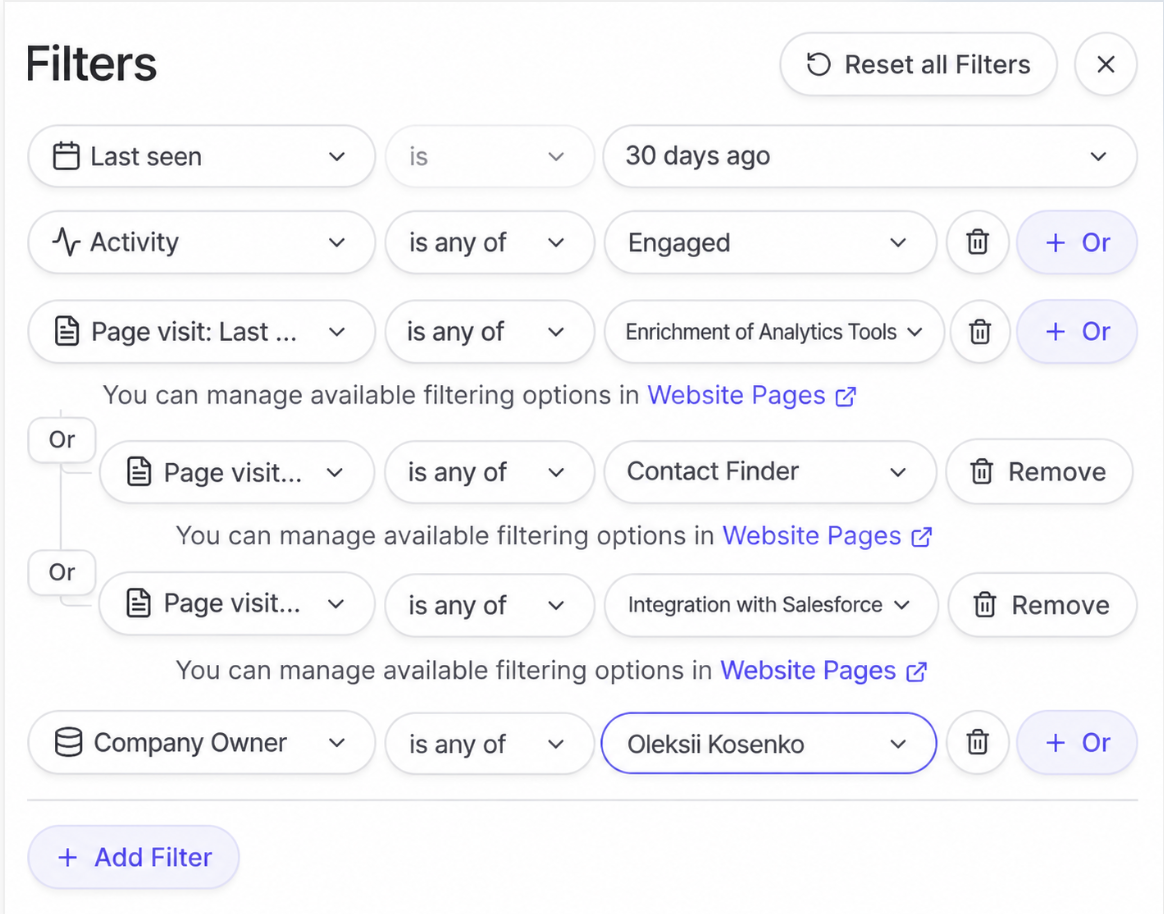
Rather than waiting for the next QBR or renewal conversation, the Customer Success Manager can proactively reach out and explore whether those additional solutions could support the customer's business objectives.
This makes upselling and cross-selling more relevant, timely, and customer-focused.
The best expansion opportunities happen when customer success, product interest, and timing come together.
3. How I Use Albacross and Slack for Customer Intelligence
One practical example from my own Customer Success workflow at Albacross is integrating website intent data with Slack.
I've configured notifications that help me see when existing customer accounts visit pages related to products or services they haven't purchased.
Instead of manually reviewing website activity across my entire customer portfolio, I receive relevant engagement signals directly in Slack.
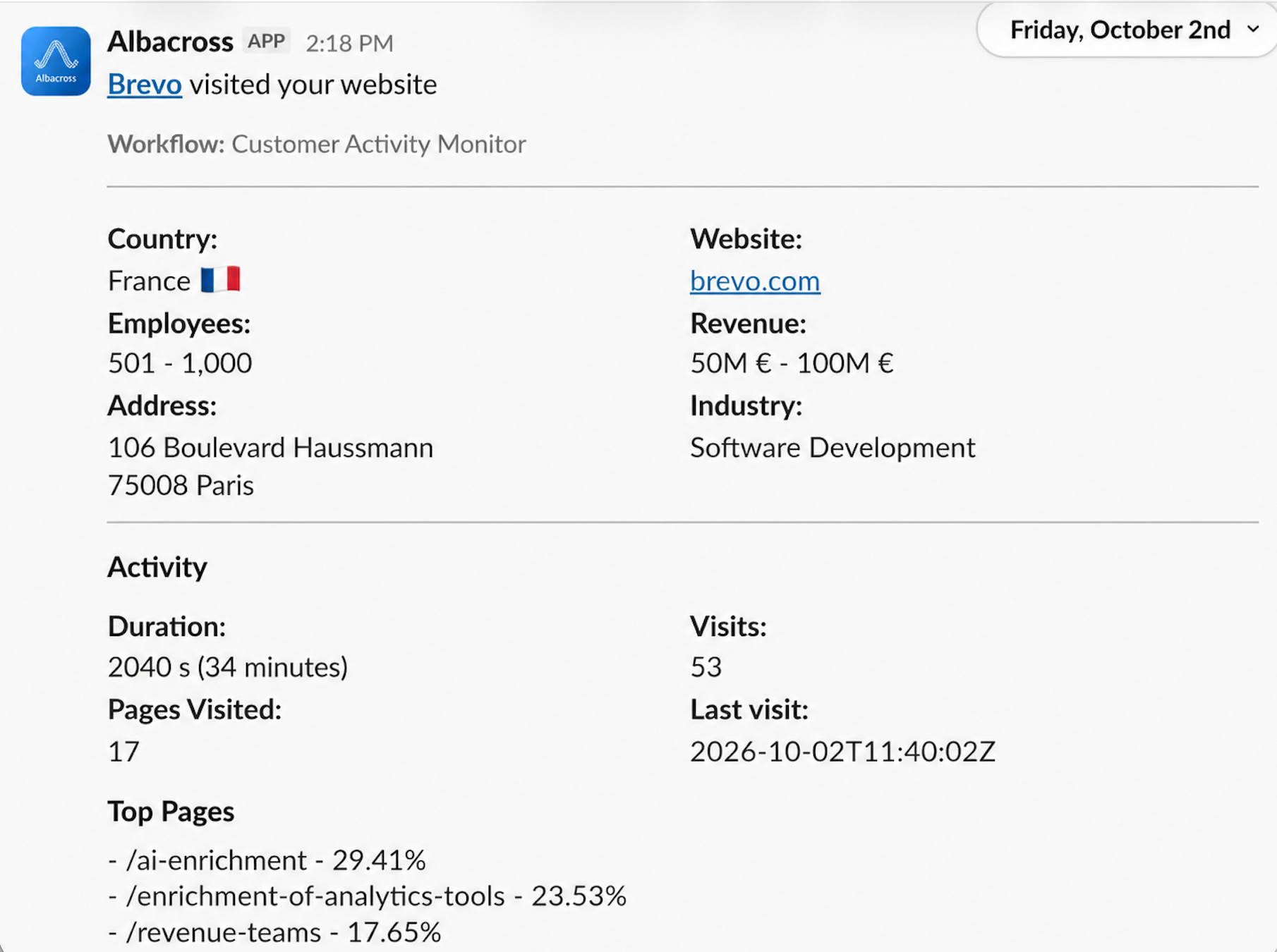
My workflow is straightforward:
- Identify: Albacross recognizes an existing customer company visiting our website.
- Filter: I focus on visits to specific product or solution pages that may indicate cross-selling opportunities.
- Notify: Relevant account engagement triggers a Slack notification.
- Review: I check the customer's current contract, product adoption, health score, and previous conversations.
- Engage: If there's a relevant opportunity, I reach out to explore whether the additional solution could deliver value.
This approach helps me prioritize customer engagement based on potential interest rather than relying exclusively on scheduled meetings.
Of course, company-level intent data doesn't tell me exactly which individual visited the website or confirm their intention to buy. But it gives me valuable context for a more informed conversation.
4. Connecting Customer Success, Sales, and Revenue Growth
For intent data to deliver business value, it needs to be actionable.
Integrating website engagement with CRM platforms such as Salesforce or HubSpot, alongside tools like Slack, can help Customer Success and Sales teams coordinate account management and expansion activities.
Instead of treating intent data exclusively as a lead generation tool, businesses can use it throughout the customer lifecycle.
The potential benefits include:
- Customer retention: Recognizing potential churn signals and initiating proactive conversations.
- Customer engagement: Understanding which topics and solutions attract interest from existing accounts.
- Upselling and cross-selling: Identifying relevant expansion opportunities based on account-level buying signals.
- Revenue growth: Supporting expansion pipeline development, customer lifetime value, and net revenue retention (NRR).
The key is combining intent data with existing customer knowledge, not treating website activity as proof of purchasing intent.
Final Thoughts: Your Next Opportunity Might Already Be a Customer
B2B businesses invest heavily in lead generation, intent data, and sales engagement to acquire new customers.
But existing customers deserve the same level of attention and intelligence.
Plus, doing an upsell or a cross-sell is about ‘’25% cheaper than finding a new customer’’ (2).
Their needs evolve, their priorities change, and their interest in your products doesn't stop after signing a contract.
By combining website intent data with customer health scores, product adoption, and regular business reviews, Customer Success teams can become more proactive in both retention and account expansion.
Because Customer Success isn't just about keeping customers happy. It's about understanding when they need help, recognizing when they're ready to grow, and reaching out at the right moment.
And sometimes, the signals are already waiting on your website.
At Albacross, we help B2B companies turn website engagement and intent data into actionable opportunities for Sales, Marketing, and Customer Success.
Resources:
- Jonathan Silver. ‘’5 Ways to Turn a Single Sale Into a Longstanding Relationship. https://www.entrepreneur.com/growing-a-business/how-to-turn-a-single-sale-into-a-longstanding-relationship/435766
- Thales (corporate author). ‘’Software Upselling and Cross-Selling Strategies’’. https://cpl.thalesgroup.com/software-monetization/upselling-cross-selling-strategies
.jpeg)
Oleksii Kosenko
CS and Ops Senior Manager

 Overview only the features needed for your use case
- Show how to adapt it to your customer qualification process


