

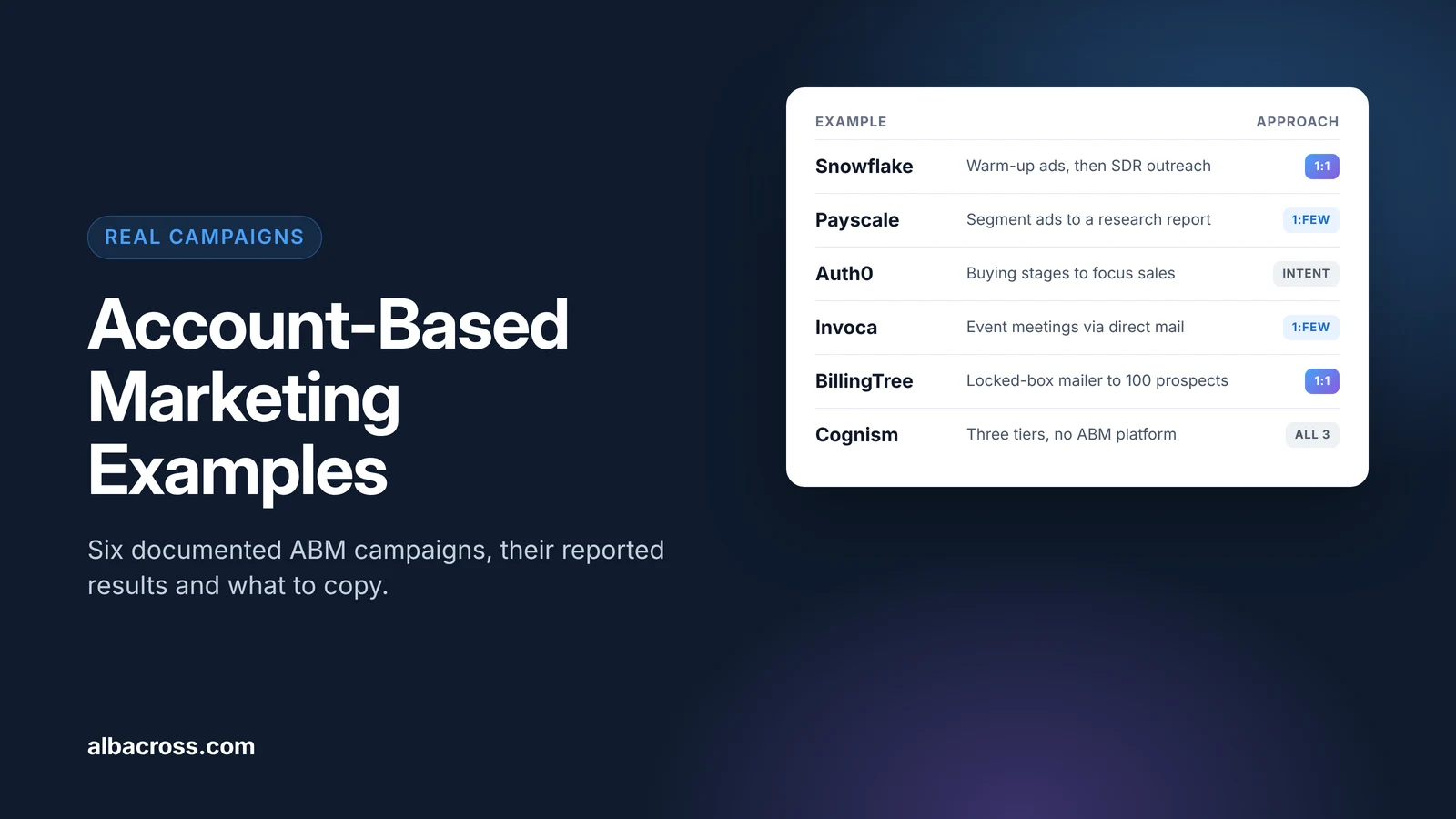
Account-based marketing (ABM) examples are real campaigns in which a B2B company picked a defined list of target accounts and coordinated marketing and sales to win them. Below are six documented examples, from Snowflake, Payscale, Auth0, Invoca, BillingTree and Cognism, each with what the team did, the results its published case study reports, and what you can copy. Each example links to the case study it comes from, and a campaign brief template at the end turns the common pattern into a plan you can use.
A Note on ABM Case Studies
Almost every public ABM case study is published by the vendor or agency that worked on the campaign, or by the company itself. The numbers are self-reported, rarely explain how they were measured, and almost never compare the target accounts with a group that was not targeted. Read them as evidence of what is possible and of which tactics teams use, not as benchmarks you should expect. We only include examples whose original case study page we could open, and we quote the figures as that page states them.
The 6 Examples at a Glance
| Company | ABM approach | Accounts targeted | Main tactics | Reported result |
|---|---|---|---|---|
| Snowflake | One-to-one at scale | Over 2,000 top accounts | Account ads, personalized landing pages, SDR outreach after 2–4 weeks of warm-up | 75% more SDR-booked meetings in ABM accounts (quarter on quarter) |
| Payscale | One-to-few, by segment | Target accounts in SMB, mid-market and enterprise | Persona-based display ads driving to a research report, CRM sync | 500% more target account traffic, 6x ROI in revenue |
| Auth0 | Intent-led prioritization for sales | Accounts in buying stages | Intent and buying-stage data for SDRs and account executives, phased rollout | $3 million pipeline increase in six weeks |
| Invoca | Event-based ABM | About 600 contacts at key accounts | Direct mail offer for a booked meeting, email, display ads, calls | More than 50 meetings, 33x ROI on campaign spend |
| BillingTree | One-to-one direct mail | Top 100 prospects | Locked box with a gift card and a video pitch | Over 60% of recipients reached out |
| Cognism | Three tiers, no dedicated ABM software | One-to-one, one-to-few and one-to-many lists | Signal-based scoring, paid media, landing pages, gifts, sales air cover | $700K in pipeline in 2025 |
1. Snowflake: One-to-One ABM for Over 2,000 Accounts
What they did. According to RollWorks' write-up of Snowflake's program (19 April 2024), an ABM team of six runs one-to-one campaigns. Target accounts come first from sales conversation data in Salesforce, with intent data used to find accounts that are not yet engaged. The team runs account-based ads through RollWorks and LinkedIn, sends SDR e-gifts, and builds personalized landing pages in Uberflip. Their "1-2 punch" has the ABM team warm an account with ads and content for 2 to 4 weeks before an SDR reaches out.
Reported results. The program scaled one-to-one experiences to "over 2,000 top accounts". Snowflake reported "a 75% increase of SDR-booked meetings in ABM accounts" quarter on quarter, and its Director of ABM is quoted: "We're achieving a 50 percent new opportunity rate with existing customers we target with ABM."
What to copy. Warm accounts before sales calls, and agree on how long the warm-up lasts. A fixed window makes it easy for marketing and SDRs to coordinate, and it gives you a clean before-and-after comparison.
2. Payscale: Segment-Based ABM Around One Strong Asset
What they did. In RollWorks' Payscale case study, sales and marketing first agreed on the target accounts. Campaigns were split into SMB, mid-market and enterprise segments, with sales naming the key personas in each. Ads were shown to those personas and drove them to Payscale's annual Compensation Best Practices Report, and account data synced both ways with Salesforce.
Reported results. Within seven months the case study reports a "500% increase in target account traffic", a "45% decrease in time to close for active opportunities" and "a 6x ROI in revenue".
What to copy. You do not need custom content for every account. One genuinely useful asset, such as original research, can carry a one-to-few program if the targeting and messaging differ by segment.
3. Auth0: Using Buying Stages to Focus Sales
What they did. 6sense's Auth0 customer story describes a phased rollout of intent and buying-stage data to sales. It began with a training pilot for SDRs and market development reps in the Americas and EMEA, then expanded to global SDR and demand generation teams, and then to a first group of account executives. Weekly office hours and manager check-ins supported adoption.
Reported results. In the pilot, reps "sourced an extra 28 opportunities with 6sense, amounting to a pipeline increase of $3 million" in six weeks. The story also reports that 80% of opportunities came from accounts in the "Purchase/Decision stages" and a "25% increase in average selling price".
What to copy. ABM depends on sales acting on the signals. Roll out new account data to a small pilot group first, train them, and expand once the pilot shows results other reps can see.
4. Invoca: Turning an Event Into an ABM Campaign
What they did. Ahead of Dreamforce 2015, Invoca targeted about 600 contacts at key accounts, according to PFL's Invoca case study (PDF). The campaign launched a month before the event. Direct mail offered an Apple Watch for booking a meeting at the event, supported by email, display ads and outbound calls. One person ran the direct mail part through Marketo.
Reported results. The goals were about 20 opportunities, 30 meetings and 10x ROI. The case study reports "more than 35 new opportunities" (175% of goal), "more than 50 meetings completed" (166% of goal) and "33x ROI on campaign spend".
What to copy. Events you already attend are a natural ABM moment. Set targets for meetings and opportunities before you start, start outreach weeks before the event, and tie the offer to a specific action such as a booked meeting.
5. BillingTree: One-to-One Direct Mail to 100 Prospects
What they did. According to agency UviaUs' BillingTree case study, the team skipped a purchased mailing list and targeted BillingTree's top 100 prospects, often C-level. Each received a locked case holding an Amazon gift card worth up to $100, with the combination withheld, and a short video pitch played when the case was opened. Prospects then started calling BillingTree.
Reported results. The page reports that "over 60% of the prospects who received the mailing have reached out to BillingTree, and 15% of those prospects have converted to opportunities", and "over 700% return on their marketing investment". The page gives two different figures for closed business, so we leave those out.
What to copy. High-cost tactics work when the list is short and every account is worth it. Build the mailer so the natural next step is a conversation with your team.
6. Cognism: Three-Tier ABM Without an ABM Platform
What they did. Cognism describes its own program in its ABM at scale playbook. It runs three layers. One-to-many uses paid media and content hubs. One-to-few uses custom landing pages and SDR outreach for accounts showing hiring or intent signals. One-to-one adds account-specific ads, personalized gifts, webinars and sales air cover. Accounts are scored by stacking several signals, and a cross-functional group reviews results every month. Cognism says it does not use dedicated ABM software, and it suggests 5 to 10 one-to-one accounts per rep, around 50 one-to-few accounts and several hundred one-to-many accounts.
Reported results. The playbook says the program was "already hitting $700K in pipeline in 2025".
What to copy. You can start ABM with the data, CRM and ad accounts you already have. Clear tiers, a scoring rule and a monthly review matter more than the tool.
What the Examples Have in Common
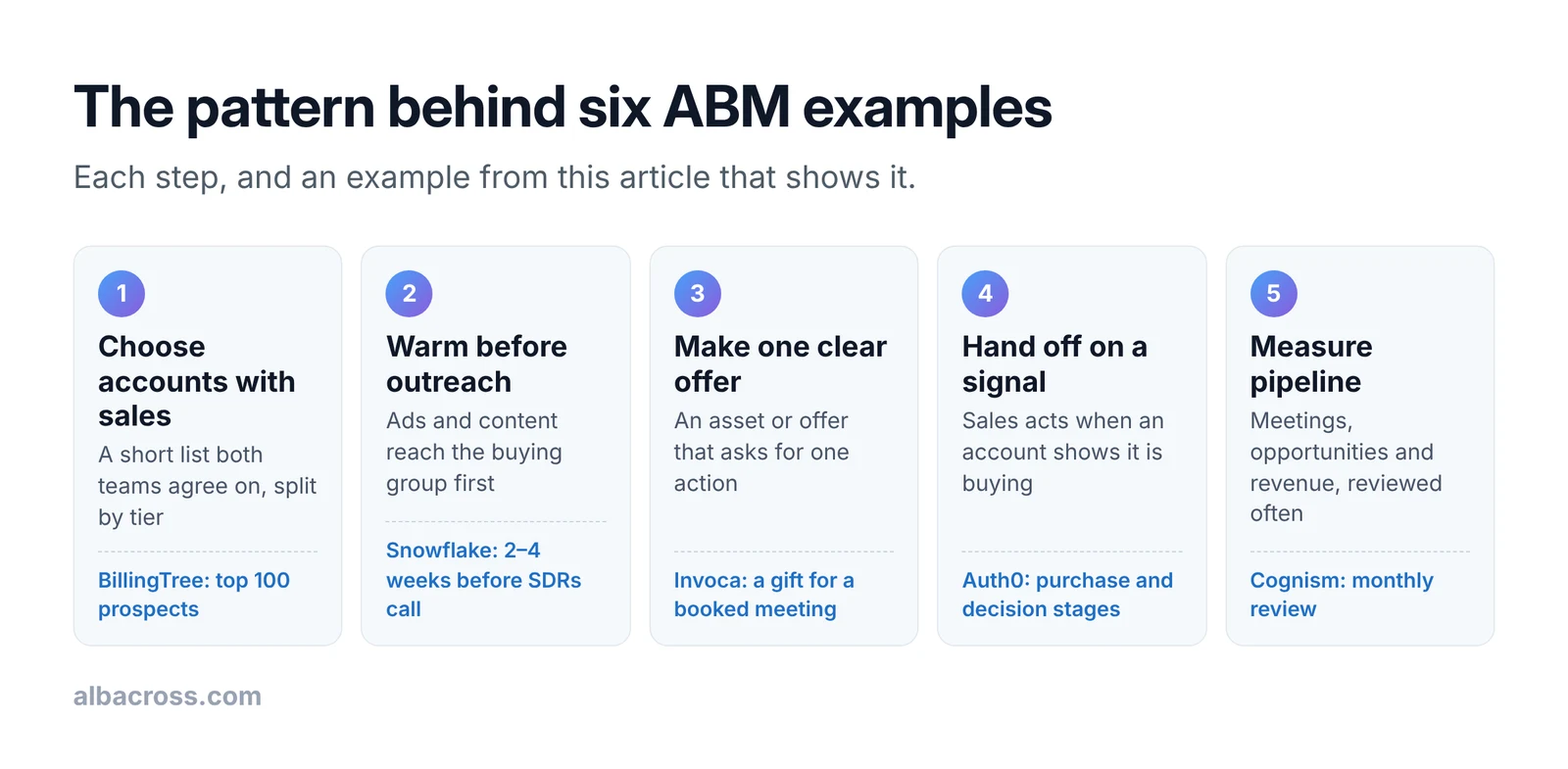
- Sales helped choose the accounts. Snowflake started from sales conversations, Payscale's sales team named the personas, and BillingTree targeted its own top prospects.
- Accounts were warmed before outreach. Snowflake used a 2 to 4 week window, and Invoca started a month before Dreamforce.
- The offer was tied to one action. Invoca's offer required a booked meeting, and BillingTree's mailer was built to prompt a call.
- Effort matched the tier. Expensive tactics such as direct mail and gifts went to short lists. Larger lists got ads and shared content.
- Results were measured in meetings and pipeline. None of the six reports success in leads or form fills.
ABM Campaign Brief Template
Use this brief to plan your own campaign. It follows the pattern above, and each line points to an example that did it.
| Field | What to decide | Example |
|---|---|---|
| Goal | Meetings, opportunities or pipeline value, with a number and a date | Invoca: about 20 opportunities and 30 meetings |
| Account list | How many accounts, chosen how, and by whom | BillingTree: top 100 prospects |
| Tier | One-to-one, one-to-few or one-to-many | Cognism: 5–10 one-to-one accounts per rep |
| Personas | The roles you need to reach in each account | Payscale: personas per segment named by sales |
| Asset or offer | The content or offer, and the one action it asks for | Payscale: research report; Invoca: meeting offer |
| Warm-up | Channels and length before sales outreach | Snowflake: 2–4 weeks of ads and content |
| Handoff | The signal that triggers sales follow-up, and who acts | Auth0: accounts in purchase or decision stages |
| Measurement | Metrics, the comparison group and the review date | Cognism: monthly cross-functional review |
For the full process behind the brief, from ideal customer profile to account-level measurement, see our step-by-step account-based marketing strategy guide.
How Albacross Supports ABM Campaigns
Albacross ABM lets you upload a target account list or build one with filters, run display and LinkedIn ads to those accounts with your own budget and schedule, and see which target accounts visit your website and what they look at. Active accounts can be pushed to Salesforce, HubSpot or Pipedrive, the account owner can be alerted in Slack or Teams, and follow-up emails and LinkedIn messages can be sent automatically. That covers the warm-up and handoff steps in the template above.
Frequently Asked Questions
What is an example of account-based marketing?
Invoca targeted about 600 contacts at key accounts before Dreamforce 2015, offered a gift for booking a meeting at the event, and supported it with email, display ads and calls. Its case study reports more than 50 meetings and more than 35 new opportunities.
What are the three types of ABM?
One-to-one ABM gives each high-value account its own plan and content. One-to-few targets small clusters of similar accounts, such as one segment or industry. One-to-many uses ads and automation to reach hundreds or thousands of accounts with lighter personalization. Cognism's program in this article uses all three.
What does a good ABM campaign include?
A target account list agreed with sales, the personas to reach in each account, a relevant asset or offer, a warm-up period before outreach, a clear handoff rule, and a goal measured in meetings, opportunities or pipeline.
Are ABM case study results reliable?
Treat them with care. Most are published by the vendor or agency involved, the numbers are self-reported, and few compare target accounts with a group that was not targeted. They are most useful for tactics, not as benchmarks.
Do you need ABM software to run account-based marketing?
No. Cognism says it runs its program without dedicated ABM software, using its data, CRM and ad platforms. ABM tools help with account targeting, intent data and reporting, which matters more as lists grow.
How do you measure an ABM campaign?
Measure what happens to the target accounts: engaged accounts, meetings, opportunities, pipeline value, win rate and deal size. Compare them with a similar group you did not target, so you know what the campaign changed.
Further Reading

Marcus Svensson
Head of Growth

 Overview only the features needed for your use case
- Show how to adapt it to your customer qualification process


