

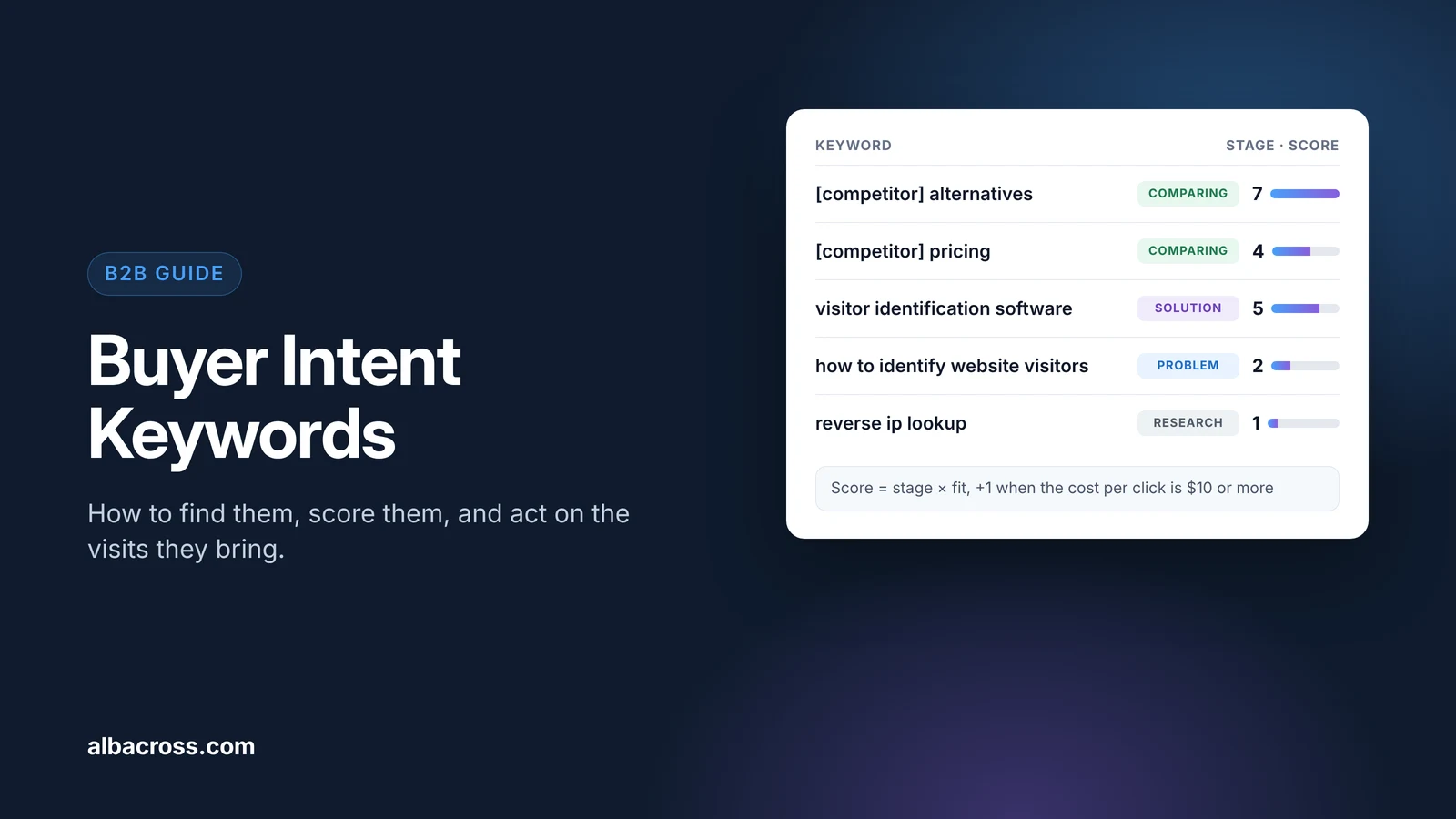
Buyer intent keywords are searches that show the person is evaluating or ready to buy, such as "[competitor] alternatives", "website visitor identification software" or "[product] pricing". They bring fewer visits than broad informational searches, but those visits come from people much closer to a decision, so they are usually the best place for a B2B team to start. This guide shows how to find them, how to score them with real search data, which page to build for each one, and what to do when the visitors they bring leave without filling in a form.
What Buyer Intent Keywords Are
Search intent describes what a person wants when they type a query. The classic model comes from Andrei Broder's paper "A taxonomy of web search" (SIGIR Forum, 2002), which split searches into three types: navigational (reach a particular site), informational (find information) and transactional (do something, such as buy or download). In his AltaVista query log sample, about 48% of queries were informational, 20% navigational and 30% transactional.
SEO tools today usually add a fourth type, commercial, for searches that compare options before buying. That gives the four intent types most marketers use:
| Intent type | What the searcher wants | B2B example | Buyer intent? |
|---|---|---|---|
| Informational | To understand a problem or concept | what is reverse ip lookup | Low |
| Navigational | To reach a specific site or page | [brand] login | None (usually existing users) |
| Commercial | To compare options before choosing | website visitor identification software, [competitor] alternatives | High |
| Transactional | To act now: buy, sign up, book a demo | [brand] pricing, [brand] free trial | Highest |
"Buyer intent keywords" means the commercial and transactional groups. In B2B, commercial keywords matter most, because almost nobody buys software straight from a search result. People compare, shortlist and then book a demo or start a trial.
The Modifiers That Signal Buyer Intent in B2B
Most buyer intent keywords are a product category, a brand or a problem plus a modifier. These are the modifiers to look for:
| Modifier group | Examples | What it tells you |
|---|---|---|
| Category nouns | software, tool, platform, app, solution, provider | The searcher knows a product type exists and is looking for one |
| Comparison | alternative(s), vs, competitors, compare, similar to | The searcher knows at least one vendor and is building a shortlist |
| Price and buying | pricing, price, cost, free trial, demo, plans, quote | The searcher is checking whether a product fits their budget |
| Evaluation | review(s), rating, G2, Capterra, pros and cons | The searcher wants proof from other buyers |
| Fit | for [industry], for [team size], for agencies, for startups | The searcher has specific requirements |
| Integration | [category] for HubSpot, [tool] Salesforce integration | The searcher wants something that works with their stack |
"Best" belongs in the comparison group too, but treat it with care. A page that ranks its own product first in a "best X" list rarely earns trust from B2B buyers. A comparison that states facts both ways usually works better.
Buyer Intent Keywords vs Intent Data Topics
The phrase has a second meaning in B2B marketing. Intent data providers track which companies are reading about which topics across a network of websites, and you choose the topics (often called keywords) to monitor. Bombora, for example, reported 17,210 intent topics in its taxonomy after its March 2025 release, and alerts customers when a business is actively researching the topics they picked.
The two meanings work together:
- Search keywords tell you what to publish and bid on, so buyers find you when they search.
- Intent topics tell you which accounts are researching your category, often before they visit your site.
A keyword list you build for SEO is a good starting point for choosing intent topics, and the reverse is also true. For how topic-level intent data is collected and scored, see our guide to what intent data is.
How to Find Buyer Intent Keywords: 6 Steps
1. Start from how your buyers compare
List your product category in the words buyers use, your main competitors, the tools you integrate with and the problems you solve. Sales call notes, lost-deal reasons and demo request forms are the best sources, because they use the buyer's own words rather than your positioning.
2. Add the modifiers
Combine each item with the modifiers above: "[category] software", "[competitor] alternatives", "[competitor] pricing", "[category] for [industry]". A spreadsheet with seeds in one column and modifiers in another gives you a long list in minutes.
3. Check search volume and cost
Run the list through a keyword tool. Google's own Keyword Planner shows estimated monthly searches and the cost to target each keyword; it needs a Google Ads account with billing details entered. Tools such as Ahrefs or Semrush add a difficulty score and estimated cost per click (CPC).
CPC is a useful shortcut for buyer intent: advertisers pay more for clicks that turn into revenue, so a high CPC usually means the searchers buy. Do not drop a keyword just because a tool shows very low volume. Long, specific B2B queries are often underestimated, and if sales hears the phrase on calls, people search for it.
4. Read the search results
Search each keyword and look at what ranks. Product pages, comparison pages and review sites mean Google treats the query as commercial. Guides and definitions mean it treats the query as informational, whatever the words suggest. Build the type of page that already ranks.
5. Mine your own Search Console
Your site may already appear for buyer intent searches without ranking well. In Google Search Console, open the Performance report, filter queries with a custom regex such as pricing|price|cost|alternative|vs|review|software|tool|platform|demo|trial, and sort by impressions. Google defines average position as "the average position of the topmost result from your site". Queries with impressions and an average position between 8 and 30 are the fastest wins, because Google already considers your page relevant.
You will also see long, question-like queries such as "which tools would you recommend for identifying which companies are visiting your website?". These read like prompts written for an AI assistant. Treat them as buyer intent and answer them directly on the page.
6. Check where buyers compare vendors
Review sites such as G2 and Capterra name categories the way buyers browse them. If your category there is "website visitor identification" and your site says "account intelligence", you are missing the phrase buyers use.
A Worked Example: Scoring 8 Real Keywords
Top-ranking guides on this topic describe types of keywords but rarely show how to choose between them. Here is a scoring model applied to real data from our own category, website visitor identification. Volumes, difficulty and CPC are US figures from Ahrefs, checked on 26 October 2026. Leadfeeder is a well-known tool in the category, so its name appears in buyer searches. Albacross competes with Leadfeeder, so these scores are from our side of the market.
Scoring rules: Stage points (research or problem = 1, solution = 2, comparing or ready to buy = 3) times fit (0 = we cannot help this searcher, 1 = partial, 2 = we solve exactly this), plus 1 if the CPC is $10 or more.
| Keyword | US searches / month | Difficulty | CPC | Stage | Fit | Score | Page to build |
|---|---|---|---|---|---|---|---|
| leadfeeder alternatives | 600 | 0 | $14.00 | Comparing (3) | 2 | 7 | Comparison page |
| website visitor identification | 700 | 5 | $14.00 | Solution (2) | 2 | 5 | Product page |
| website visitor identification software | 400 | 6 | $10.00 | Solution (2) | 2 | 5 | Same product page |
| website visitor tracking tools | 500 | 5 | $14.00 | Solution (2) | 2 | 5 | Tool comparison guide |
| leadfeeder pricing | 200 | 0 | $10.00 | Comparing (3) | 1 | 4 | Pricing section on the comparison page |
| leadfeeder review | 200 | 2 | $8.00 | Comparing (3) | 1 | 3 | Covered by the comparison page |
| how to identify website visitors | 250 | 4 | $6.00 | Problem (1) | 2 | 2 | How-to guide |
| reverse ip lookup | 4,600 | 68 | $0.40 | Research (1) | 1 | 1 | Only with a free tool or a deep guide |
Three things stand out:
- Volume and intent point in different directions. "reverse ip lookup" has 23 times the searches of "leadfeeder pricing", but advertisers pay 25 times more per click for the pricing query ($10.00 against $0.40). Most people looking up an IP address are not buying software.
- Fit lowers some high-intent keywords. Someone searching "leadfeeder pricing" may simply want Leadfeeder's price. A comparison page can answer that honestly and show the alternative, but the searcher is less likely to switch than someone searching "alternatives".
- Several keywords share one page. "website visitor identification" and "website visitor identification software" have the same intent, so they belong on one page. Splitting them would make two weaker pages compete with each other.

A Template You Can Copy
Copy these columns into a spreadsheet and score every keyword on your list the same way:
| Column | What to enter |
|---|---|
| Keyword | The exact search phrase |
| Monthly searches | From Keyword Planner or your SEO tool, for your main market |
| Difficulty | From your SEO tool; note it, but don't let it decide alone |
| CPC | Estimated cost per click; add 1 point at your own threshold (we used $10) |
| Stage | 1 research or problem, 2 solution, 3 comparing or ready to buy |
| Fit | 0 cannot help, 1 partial, 2 exact |
| Score | Stage × fit + CPC point (maximum 7) |
| Target page | The one URL that should rank for this keyword |
| Current position | From Search Console, so you can see progress |
Work from the highest score down. Group keywords with the same intent onto one page before you write anything.
Match Each Keyword to the Right Page
A buyer intent keyword sent to the wrong page wastes the visit. Use the stage to decide the page type:
- Problem-aware searches ("how to identify website visitors") need a practical guide that names the tool category and links to your product page.
- Solution-aware searches ("website visitor identification software") need a product or category page that explains how it works, what it costs to run and what it connects to.
- Comparing searches ("[competitor] alternatives") need an honest comparison page. State where the competitor is stronger as well as where you are. Buyers check, and a one-sided page loses them.
- Ready to buy searches ("[your brand] pricing") need a pricing page with real numbers or a clear explanation of how pricing works, and one obvious next step.
What to Do After the Click
Ranking for buyer intent keywords is only half the job. Many B2B visitors read a comparison or pricing page and leave without filling in a form, often because they are still building a shortlist with colleagues. If you only count form fills, a page can look like a failure while it attracts exactly the right companies.
- Identify the companies. Website visitor identification tools match visits to the companies behind them, so you can see which organisations read your comparison and pricing pages. Our guide on how to identify website visitors explains the methods and their limits.
- Prioritize by page and fit. A target-fit company that viewed a pricing page and a comparison page in the same week is a stronger lead than one that read a single blog post. Treat these visits as buying signals and score them.
- Act quickly. Send the best accounts to the account owner, add them to a retargeting audience, or start a short outreach sequence that refers to the problem they were researching, not to the fact that they visited.
How to Measure Results
Track buyer intent keywords as their own group, separate from brand and informational traffic:
- Search Console, monthly: impressions, clicks and average position for the regex filter above. Impressions rise first, then position, then clicks.
- Analytics: visits and conversions on the pages you built for these keywords.
- Accounts: how many target-fit companies visited those pages, and how many of them entered the pipeline within 90 days.
The last measure is the one that matters for B2B. A comparison page with modest traffic from the right companies is worth more than a glossary page with many times the visits from students and job seekers.
Common Mistakes
- Choosing keywords by volume. As the example shows, the biggest keyword can carry the least buying intent.
- Sending commercial searches to the homepage. The homepage rarely answers "alternatives" or "pricing" questions well enough to rank or convert.
- Targeting navigational searches. "[brand] login" brings existing users, not buyers.
- Writing self-ranked "best" lists. They can rank for a while, but B2B buyers discount them.
- Ignoring the visit after the click. Without knowing which companies arrived, you cannot tell a page that works from one that doesn't.
How Albacross Helps
Albacross Identify shows which companies visit your website and which pages they view, so you can see which accounts arrived on the comparison, pricing and product pages you built for buyer intent keywords. Signal combines that website behavior with firmographic fit, CRM history and third-party intent into one priority score, and sends scored accounts to your CRM, Slack, Teams or ad audiences.
See which companies visit your website.
Frequently Asked Questions
What are buyer intent keywords?
Buyer intent keywords are search queries that show the person is comparing products or ready to buy. They usually combine a product, brand or category with words such as "software", "alternatives", "pricing", "review" or "demo".
What are examples of buyer intent keywords in B2B?
Examples are "website visitor identification software", "[competitor] alternatives", "[competitor] pricing", "[category] for HubSpot" and "[brand] free trial". Informational queries such as "what is reverse ip lookup" usually carry low buying intent.
What is the difference between commercial and transactional intent?
Commercial intent means the searcher is comparing options before choosing, for example "[competitor] alternatives". Transactional intent means they want to act now, for example "[brand] pricing" or "[brand] demo". Both count as buyer intent.
Are buyer intent keywords the same as intent data?
No. Buyer intent keywords are what people type into a search engine. Intent data shows which companies are researching topics across many websites. Providers often call their topics keywords, and the same list can guide both your content and the topics you monitor.
How can I find buyer intent keywords for free?
Use Google Search Console to see which buyer intent queries your site already appears for, Google autocomplete and "People also ask" for variations, and Keyword Planner for search volume. Sales call notes and review-site categories add the phrases buyers actually use.
Are high-volume keywords better?
Not for buyer intent. In our example, "reverse ip lookup" had 4,600 US searches a month but a CPC of $0.40, while "leadfeeder pricing" had 200 searches and a CPC of $10.00. Score keywords by stage and fit, then use volume to break ties.
Do buyer intent keywords matter for AI search?
Yes. People ask AI assistants the same comparison and pricing questions in longer form, and some of those questions already show up in Search Console. Pages that answer them directly, with clear facts and honest comparisons, are easier for both search engines and AI assistants to use.
Further Reading

Marcus Svensson
Head of Growth

 Overview only the features needed for your use case
- Show how to adapt it to your customer qualification process


