

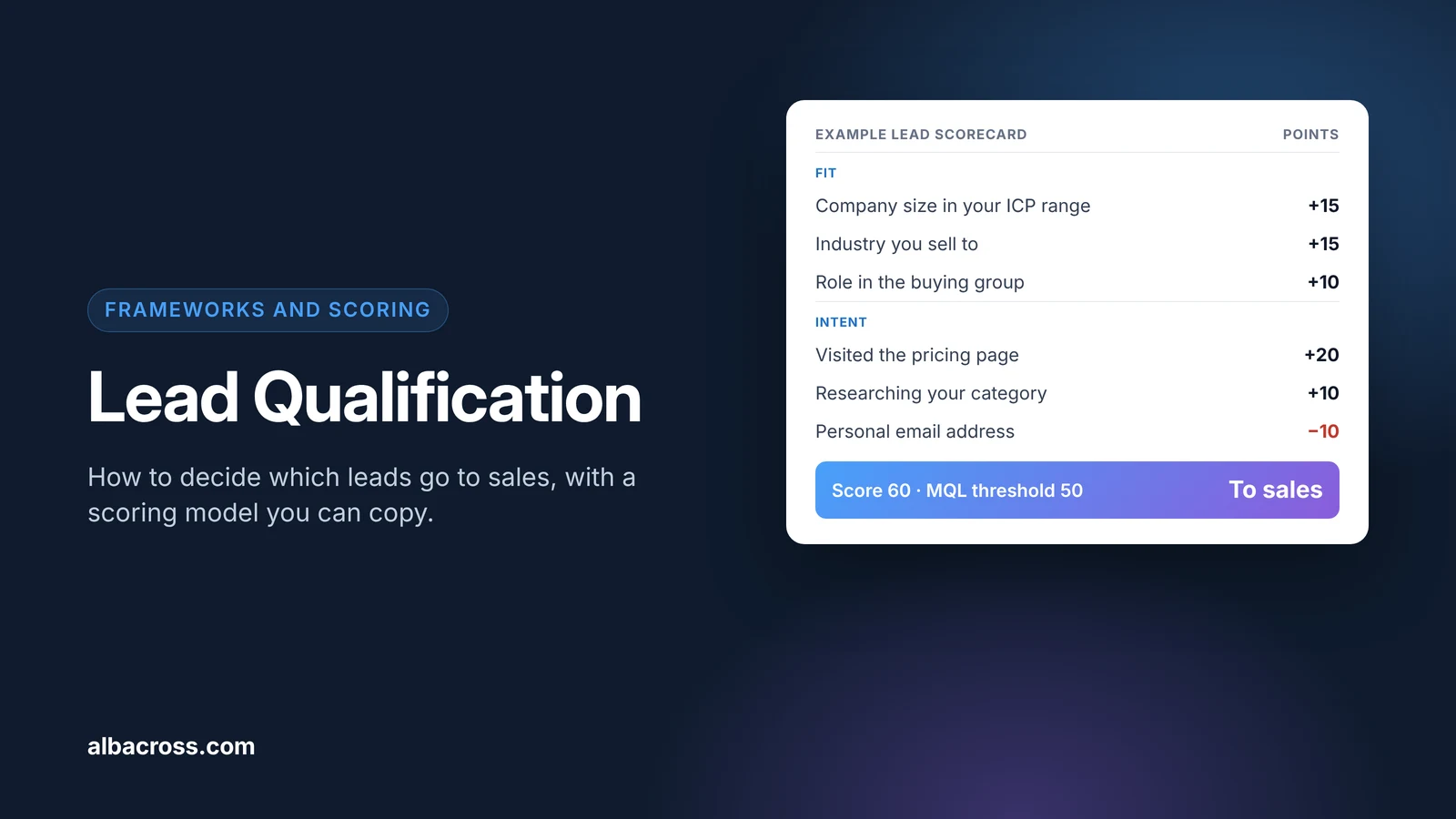
Lead qualification is the process of deciding which leads are worth a sales conversation, based on how well they fit your ideal customer profile and how strongly they show intent to buy. Most B2B teams do it in two stages: marketing scores leads on fit and behavior until they become marketing-qualified leads (MQLs), and sales confirms need, authority and timing in a conversation before accepting them as sales-qualified leads (SQLs). This guide covers the process step by step, compares the common frameworks (BANT, CHAMP, GPCTBA/C&I and MEDDIC), and gives you a lead scoring model with point values and a worked example.
What Lead Qualification Means
A lead is anyone who has shown some interest: a form fill, a webinar signup, a company visiting your website. Not every lead deserves a sales rep's time. Qualification sorts them so that sales talks to the people who can buy, and marketing keeps nurturing the rest.
Most teams use these stages:
| Stage | What it means | Who decides |
|---|---|---|
| Lead | A person or company that has shown interest, not yet assessed | Nobody yet |
| MQL (marketing-qualified lead) | Fits your profile and has shown enough interest to be worth following up | Marketing, usually through a score |
| SQL (sales-qualified lead) | Sales has confirmed a real need and a reason to buy, and is ready to work it | Sales, usually after a call |
| Opportunity | A deal in the pipeline with a value and an expected close date | The account executive |
HubSpot's sales qualification guide defines the two middle stages this way: a marketing-qualified lead is "a prospect who has shown enough interest in a product or service to warrant marketing attention, but isn't yet ready for a direct sales conversation", and a sales-qualified lead is "a prospect that the sales team has vetted as ready for direct engagement."
The Three Things You Qualify On
Every qualification method, whether it is a score or a set of questions, checks some mix of three things:
- Fit: does the company and the person match the customers you win? Company size, industry, region, tech stack and the person's role.
- Intent: are they actively looking? Visits to pricing or product pages, repeat visits, a demo request, or third-party data showing the company is researching your category.
- Readiness: can they buy now? Budget, authority, a defined need and a timeline. This is usually only clear in a conversation.
Scoring handles fit and intent well, because both can be measured from data. Readiness is what frameworks like BANT and MEDDIC are for. A good process uses both: the score decides who gets a call, and the call decides who becomes an opportunity. For more on reading intent, see B2B buying signals and how to act on them.
How to Qualify Leads in 5 Steps
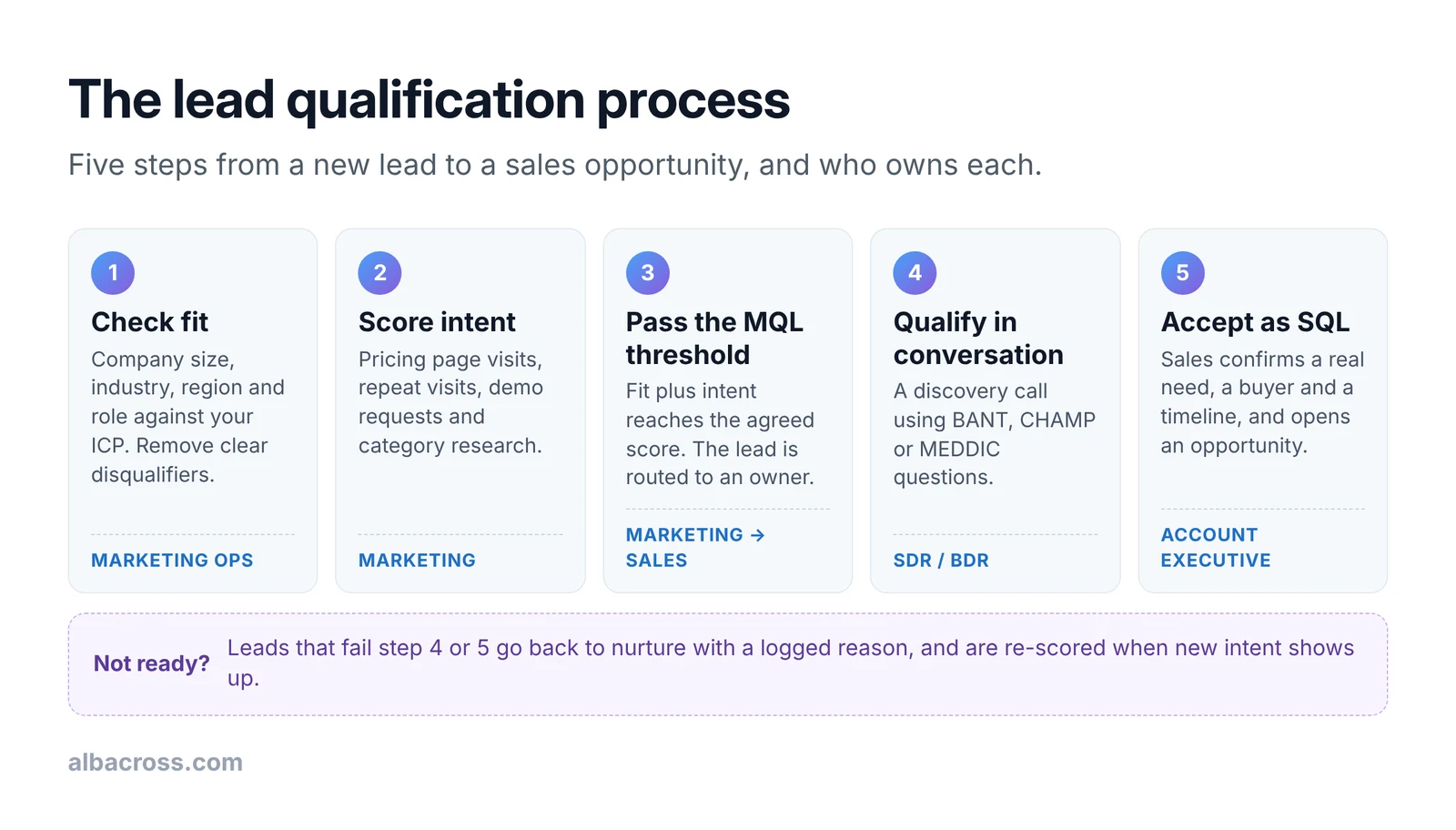
Step 1. Check fit against your ideal customer profile
Write your ideal customer profile (ICP) as filters you can apply to a lead record: employee range, industries, countries you serve and the roles involved in buying. Add hard disqualifiers too, such as students, job seekers, competitors, existing customers (who belong with account management) and countries you cannot sell to. Leads that hit a disqualifier never reach sales, whatever their activity. Our guide to building an ideal customer profile walks through how to define it.
Step 2. Score intent and engagement
Give points for actions that suggest buying interest, and weight them by how close they are to a purchase. A pricing page visit or a demo request says more than an email open. Third-party intent data can add a signal for companies researching your category before they ever fill in a form; see what intent data is and how it is used.
Step 3. Set an MQL threshold and route the lead
Agree with sales on the score that makes a lead an MQL, and what happens next: who gets it, how they are alerted, and how fast they follow up. A written rule such as "MQLs are called within one working day" matters more than the exact threshold. Review the threshold after a month or two by checking how many MQLs sales accepted.
Step 4. Qualify in a conversation
An SDR or BDR runs a short discovery call using a framework (see below). The goal is to confirm a real problem, the people involved in the decision, and a timeline, not to pitch.
Step 5. Accept as SQL, or send back with a reason
If the call confirms need and timing, the lead becomes an SQL and an opportunity is opened. If not, it goes back to nurture with a logged reason ("no budget until Q3", "wrong team"), and it is re-scored when new intent appears. Reviewing these reasons each month is the fastest way to improve your scoring.
Lead Qualification Frameworks Compared
Frameworks give sales a shared checklist for discovery calls. None is right for every team. The table shows what each one covers and where it falls short.
| Framework | What the letters stand for | Suits | Limitation |
|---|---|---|---|
| BANT | Budget, Authority, Need, Timeline | Shorter sales cycles with one main decision-maker | Buyers early in research often have no set budget, so strict BANT can disqualify good leads too soon |
| CHAMP | Challenges, Authority, Money, Prioritization | Teams that want to start the call with the buyer's problem rather than budget | Says little about how the decision will be made |
| GPCTBA/C&I | Goals, Plans, Challenges, Timeline, Budget, Authority, Negative Consequences and Positive Implications | Consultative sales where reps help the buyer build the case | Long, and needs experienced reps to run well |
| MEDDIC | Metrics, Economic Buyer, Decision Criteria, Decision Process, Identify Pain, Champion | Complex deals with several stakeholders and a formal buying process | Too heavy for small, fast deals |
Sources for the letter meanings: HubSpot's articles on BANT, CHAMP and MEDDIC and GPCTBA/C&I, which HubSpot says it developed internally for exploratory calls. A longer variant of MEDDIC, MEDDPICC, adds Paper Process and Competition, as described on meddicc.com.
A practical rule: use BANT or CHAMP for SDR discovery calls on inbound leads, and MEDDIC for account executives managing larger deals. Many teams combine them, because they answer different questions at different stages.
Lead Qualification Questions to Ask
These questions cover the areas the frameworks share. Ask them in your own words, and not all in one call.
- Need or challenge: What made you look into this now? What happens if nothing changes?
- Current situation: How do you handle this today? What have you tried?
- Authority: Who else will be involved in choosing a solution? Who signs off on the budget?
- Budget: Is there a budget set aside for this, or would it need a business case?
- Timeline: When do you need something in place, and what is driving that date?
- Decision process: What steps does a purchase like this go through at your company, such as security review or procurement?
- Success: How will you measure whether this worked?
Lead Scoring Model Template
Below is a starting model you can copy into your CRM or marketing automation tool. The point values are illustrative. Adjust them to your own data once you have a few months of results.
| Category | Attribute | Points |
|---|---|---|
| Fit | Company size in your ICP range | +15 |
| Fit | Industry you sell to | +15 |
| Fit | Country or region you serve | +5 |
| Fit | Role: decision-maker or budget holder | +15 |
| Fit | Role: other member of the buying group | +10 |
| Intent | Demo or contact request | +30 |
| Intent | Visited the pricing page (last 14 days) | +20 |
| Intent | Three or more visits in 14 days | +10 |
| Intent | Company researching your category (third-party intent) | +10 |
| Engagement | Downloaded a guide or attended a webinar | +5 |
| Engagement | Opened or clicked marketing emails | +5 |
| Negative | Personal email address | −10 |
| Negative | Visited only the careers page | −30 |
| Decay | No activity for 30 days | −10 from intent and engagement points |
Rules that go with the table:
- A lead becomes an MQL at 50 points, and at least 25 of those must come from fit. This keeps very active but poor-fit leads away from sales.
- A demo or contact request from a lead with 25 or more fit points goes straight to sales, whatever the total.
- Hard disqualifiers (competitors, students, existing customers) override the score.
- Fit and intent are scored separately so sales can see why a lead qualified.
Worked Example: Scoring Three Leads
The following example is illustrative. The company sells B2B software to companies with 100 to 2,000 employees in software and professional services, in Europe.
| Lead | Fit | Intent and engagement | Total | Outcome |
|---|---|---|---|---|
| A: VP of Marketing, 800-employee software company in Sweden | Size 15, industry 15, region 5, decision-maker 15 = 50 | Pricing page 20, four visits this week 10, company researching the category 10 = 40 | 90 | MQL. The SDR call confirms a budget review next quarter and two other people in the decision. Accepted as SQL. |
| B: Marketing coordinator, 60-employee software company in the UK | Size 0 (below range), industry 15, region 5, buying group 10 = 30 | Downloaded a guide 5, opened emails 5 = 10 | 40 | Stays in nurture. Re-scored if the company starts visiting product or pricing pages. |
| C: Owner of a five-person agency outside Europe, Gmail address | Size 0, industry 0, region 0, decision-maker 15 = 15; personal email −10 | Demo request 30 = 30 | 35 | Not routed to an account executive, because fit is below 25. Gets a reply with self-serve resources instead. |
Lead C shows why fit and intent should be scored separately. A demo request is strong intent, but without fit the deal is unlikely to close, and a rep's time is better spent on Lead A.
Common Lead Qualification Mistakes
- Scoring email opens heavily. Opens are easy to inflate and say little about buying. Weight page visits and direct requests higher.
- No negative scoring or decay. Without them, scores only go up, and old leads look hotter than they are.
- A threshold sales never agreed to. If sales did not help set the MQL definition, they will not trust the leads.
- Disqualifying on budget too early. Many buyers have no set budget when they start researching. A clear need and timeline can matter more at first.
- Never reviewing the model. Compare scores with closed-won and closed-lost deals every quarter and adjust the points.
What to Look for in Lead Scoring Software
Many CRM and marketing automation platforms include lead scoring. When you compare tools, check:
- Fit data: can it fill in company size, industry and location automatically, or does it rely on what people type into forms?
- Intent signals: does it use website behavior and third-party intent, or only email and form activity?
- Separate fit and intent scores: can sales see why a lead scored high?
- Negative scoring and decay: can scores go down as well as up?
- Routing and alerts: can it assign MQLs to an owner and notify them in the tools they use?
- Anonymous visitors: can it score companies that visit your website but never fill in a form? Scoring based only on forms and email starts after a form fill.
How Albacross Helps with Lead Qualification
Albacross Signal scores every company by fit and real-time behavior. Behavior, firmographics, CRM history and third-party intent are combined into a single priority score, and you can add your own intent data and custom attributes. High-intent accounts that match your ICP can be pushed to your CRM automatically, and the owner can be notified in Slack, Teams or email when a scored account visits pages that signal buying intent.
Because Albacross identifies the companies visiting your site, this scoring also covers accounts that have not filled in a form yet, so they can be scored and routed before they contact you. See how Albacross Signal scores accounts.
Frequently Asked Questions
What is lead qualification?
Lead qualification is the process of deciding which leads are worth a sales conversation. It checks how well a lead fits your ideal customer profile, how much intent it shows, and whether it is ready to buy, and it moves leads from MQL to SQL to opportunity.
What is the difference between lead scoring and lead qualification?
Lead scoring is one part of lead qualification. Scoring gives points for fit and behavior so marketing can decide which leads are MQLs. Qualification is the whole process, including the sales conversation that confirms need, authority and timing.
What is the difference between an MQL and an SQL?
An MQL has shown enough interest and fit for marketing to pass it on, but is not yet confirmed as ready to buy. An SQL has been checked by sales, usually in a call, and is ready for a direct sales process.
Which lead qualification framework should I use?
It depends on your deals. BANT and CHAMP are short and suit discovery calls on inbound leads. MEDDIC suits complex deals with several stakeholders. Many teams use one for SDR calls and another for account executives.
How many points should a lead need to become an MQL?
There is no standard number. Start with a threshold that requires both fit and intent, such as 50 points with at least half from fit, then adjust it based on how many MQLs sales accepts and how many become opportunities.
Who should qualify leads, marketing or sales?
Both. Marketing qualifies on fit and intent through scoring, and sales qualifies on readiness in a conversation. The two teams should agree in writing on the MQL and SQL definitions and on how fast sales follows up.
Further Reading

Marcus Svensson
Head of Growth

 Overview only the features needed for your use case
- Show how to adapt it to your customer qualification process


