

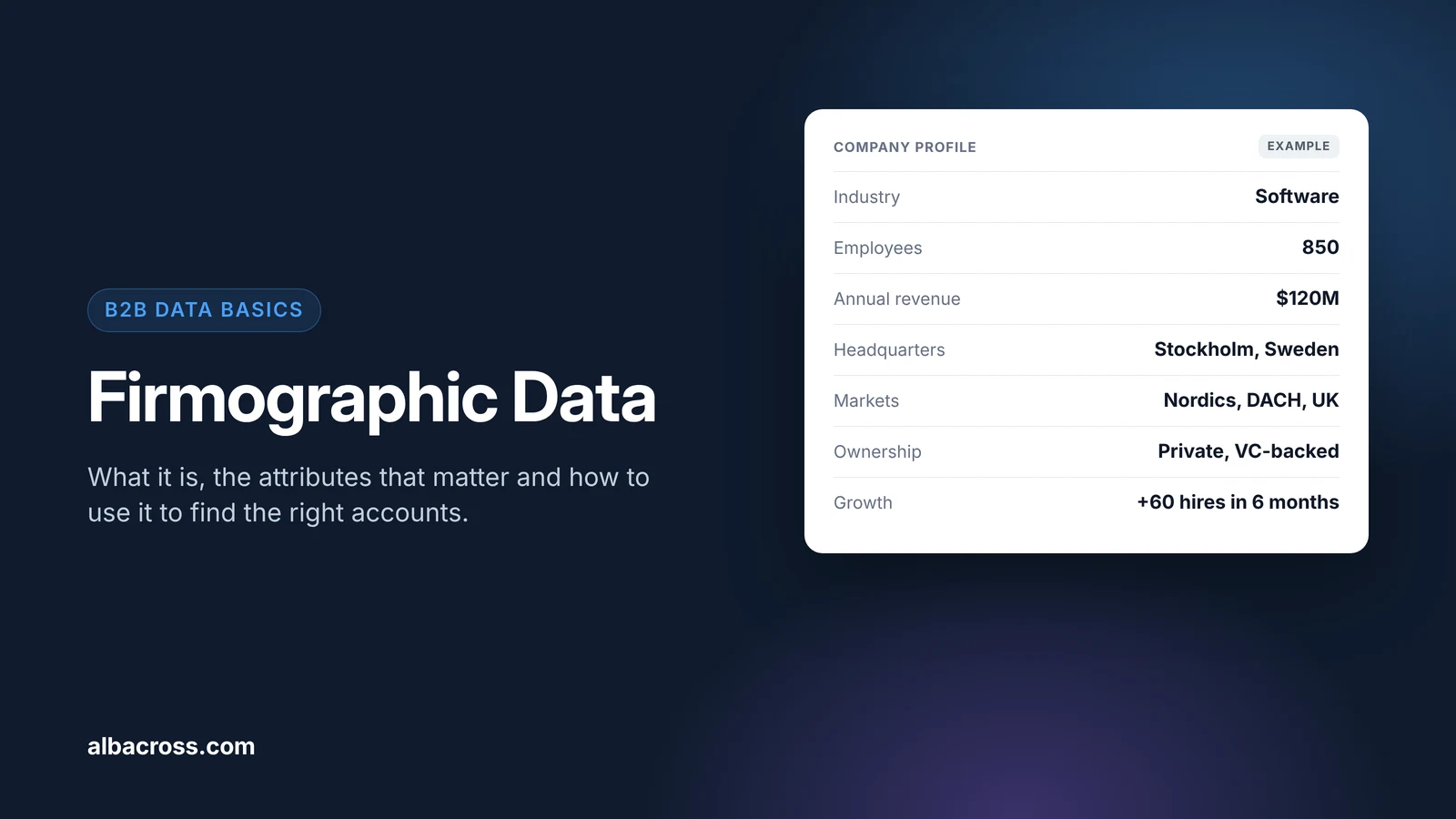
Firmographic data is information that describes a company as a whole: its industry, number of employees, revenue, location, legal structure and growth. It does for B2B what demographics do for consumer marketing, letting you group companies into segments, define your ideal customer profile (ICP) and decide which accounts sales and marketing should spend time on. This guide covers the main firmographic attributes with examples, how firmographic data differs from demographic, technographic and intent data, where it comes from, how accurate it is, and a worked segmentation example you can copy.
What Firmographic Data Includes
The table lists the attributes most B2B teams use, an example value for each, and how the value is usually obtained. The last column matters: some attributes are reported by the company itself, while others are estimated by data providers and can be off by a wide margin.
| Attribute | Example | Typical source | How reliable |
|---|---|---|---|
| Industry | Software publishing | Registry codes, website, provider classification | Good for clear cases, weak for companies that span several industries |
| Employee count | 850 | Annual reports, professional profiles, provider models | Usually given as a range; often estimated for private companies |
| Annual revenue | $120 million | Public filings (listed companies), registry accounts, provider models | Exact for listed companies; often modeled for private ones |
| Location | Headquarters in Stockholm; offices in Berlin and London | Registry, website | Headquarters is reliable; office lists go out of date |
| Legal form and ownership | Private limited company, venture-backed | Company registry, funding announcements | Reliable from registries |
| Company age | Registered in 2014 | Company registry | Reliable |
| Growth | 60 new hires in six months | Job postings, headcount changes over time | A useful signal, but changes quickly |
| Corporate structure | Subsidiary of a larger group | Registry, annual reports | Important for enterprise deals, often missing in databases |
Some guides also list technology stack or funding stage as firmographics. In practice, technology data is usually treated as its own category (technographics), as described below.
Firmographic vs Demographic vs Technographic vs Intent Data
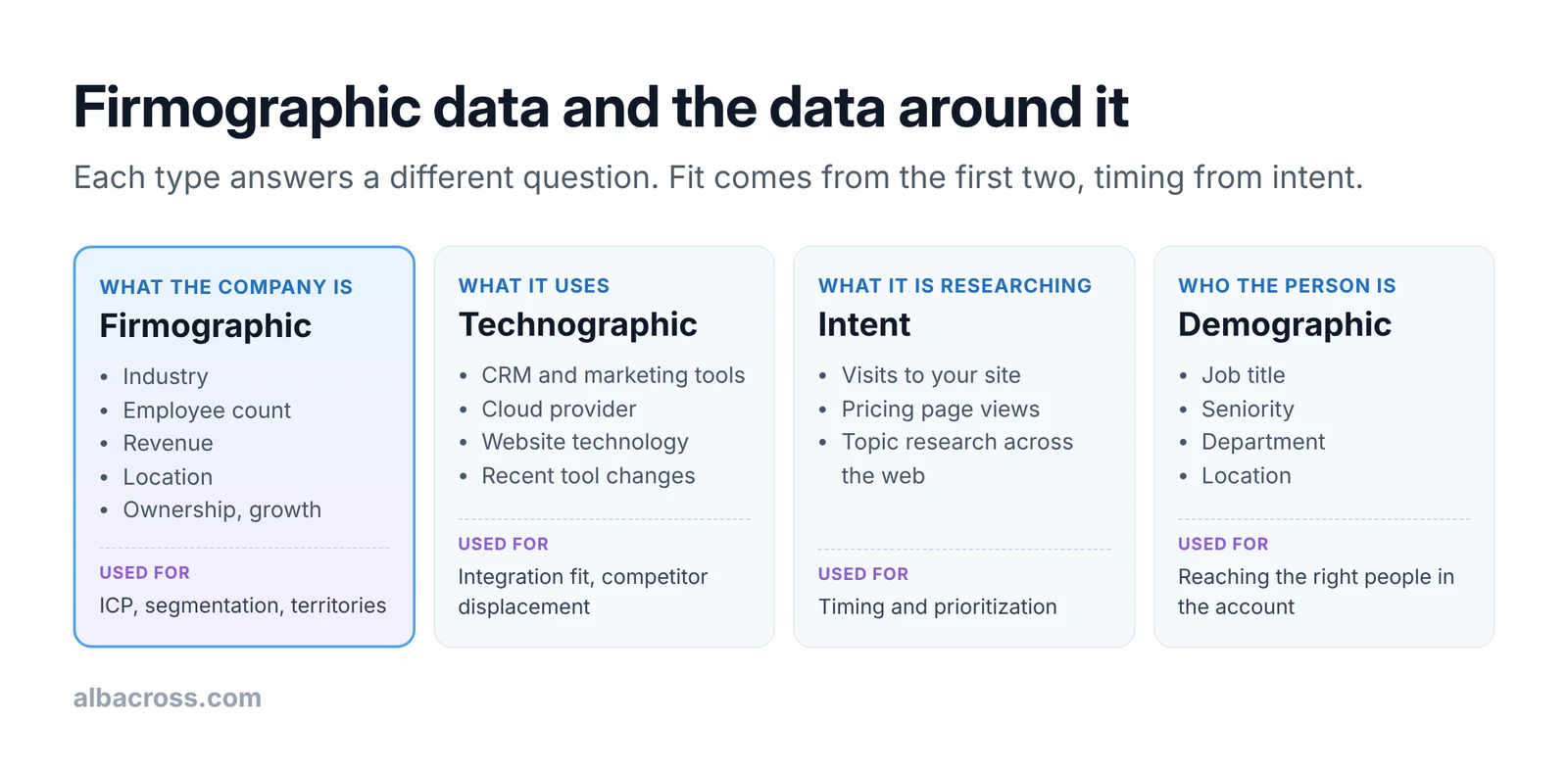
These data types describe different things, and B2B teams usually need all four. The example below uses one company record to show the difference.
| Data type | Question it answers | Example for one account | Main use |
|---|---|---|---|
| Firmographic | What kind of company is this? | Software, 850 employees, $120 million revenue, Sweden | ICP fit, segmentation, territories |
| Technographic | What tools does it use? | Uses HubSpot and Salesforce | Integration fit, replacing a competitor |
| Intent | Is it looking to buy now? | Visited your pricing page twice this week; researching your category | Timing and prioritization |
| Demographic | Who are the people involved? | Head of Marketing, VP of Sales, two SDR managers | Reaching the right people with the right message |
Firmographic and technographic data tell you whether an account could be a customer. Intent data tells you whether it is likely to buy soon. A common mistake is to rely on fit alone, which produces large target lists of companies that are not in the market. For more on the timing side, see what intent data is and how it is used.
Industry Classification Codes
Industry is the attribute most often used for segmentation, and also the one most often inconsistent between sources. Official classification systems help, because they give every company a code instead of a free-text label:
- NACE is, in Eurostat's words, "the classification of economic activities in the European Union (EU)". According to Eurostat, the newest version, NACE Rev. 2.1, was adopted by the European Commission in October 2022 and is used for European statistics from 2025 onwards.
- SIC codes are still in use in the United States. The SEC lists the Standard Industrial Classification codes that appear in companies' EDGAR filings.
- NAICS is the system used for business statistics in North America, and many US data providers classify companies with it.
Codes are precise but not always practical. A software company that sells to banks may be coded as software publishing, while your sales team thinks of it as fintech. Most teams keep the official code and add their own industry label on top that matches how they sell.
Company Size: Use Bands, Not Exact Numbers
Employee and revenue figures for private companies are often estimates, so segment on ranges rather than exact values. If you sell in Europe, the EU's own SME definition is a useful standard. It uses staff headcount plus either turnover or balance sheet total:
| Category | Staff headcount | Turnover | or Balance sheet total |
|---|---|---|---|
| Micro | < 10 | ≤ €2 million | ≤ €2 million |
| Small | < 50 | ≤ €10 million | ≤ €10 million |
| Medium-sized | < 250 | ≤ €50 million | ≤ €43 million |
Companies above the medium-sized ceilings are large enterprises. Many sales teams split that group further, for example 250 to 1,000 and 1,000 or more employees, because buying processes change a lot with size.
Where Firmographic Data Comes From
- Your own CRM. Fields filled in by sales or by forms. Often incomplete, but it reflects your actual customers.
- Company registries. National registries such as Companies House in the UK or Bolagsverket in Sweden hold legal names, registration dates, legal form and, for many companies, filed accounts.
- Public filings. Listed companies publish revenue and headcount in annual reports and regulatory filings.
- The company's own website and job postings. Useful for locations, products and hiring growth.
- B2B data providers. They combine the sources above, fill gaps with their own models and keep records updated. Ask any provider which fields are reported and which are modeled, and how often records are refreshed. Our guide to B2B data enrichment shows how to test a provider on your own records.
- Website visitor identification. Tools that identify the companies visiting your website can attach firmographic data to each visit, so you see the size and industry of anonymous visitors. See how to identify website visitors.
How Accurate Is Firmographic Data?
Accuracy varies by attribute and by company type. A few rules of thumb:
- Listed companies are the most accurate, because revenue and headcount are published.
- Private companies often have estimated revenue and employee counts. Treat them as ranges.
- Data goes stale. Companies grow, move, merge and change names. Refresh records on a schedule and before every major campaign.
- Industry labels differ between providers. Map them to your own industry list rather than trusting each source's label.
A quick test before you buy or rely on a data source: take 50 of your current customers, whose details you know, and compare them with the provider's records. The share that matches tells you more than any accuracy claim.
Is Firmographic Data Covered by GDPR?
Data about a company is generally not personal data. The European Commission states that the data protection rules "don't govern data about companies or any other legal entities". There are two important exceptions on the same page: information about one-person companies may be personal data when it identifies a natural person, and the rules do apply to personal data about people in a professional context, such as an employee's business email address. In practice, firmographic attributes are company data, while contact details attached to them are personal data and need a lawful basis.
How to Use Firmographic Data
- Define your ICP. Find the industries, size bands and regions where you win most often and keep customers longest. Our guide to building an ideal customer profile walks through it.
- Size your market. Count the companies that match your ICP to see how big the opportunity is in each region.
- Segment campaigns. Write different messages for different industries and size bands, because their problems differ.
- Score leads. Give points for firmographic fit so sales sees the best-fit accounts first. Our lead qualification guide includes a scoring model with fit points.
- Build ABM tiers and territories. Use size and region to split accounts between reps and between one-to-one, one-to-few and one-to-many programs. See the ABM strategy guide.
Worked Example: Firmographic Segmentation
The following example is illustrative. A company sells HR software and wants to focus its outbound and advertising budget.
- Look at won deals. Of its customers from the last two years, most are manufacturing and logistics companies with 250 to 2,000 employees in the Nordics and Germany. Deals with companies under 100 employees were small and churned early.
- Write the filters. Industry: manufacturing or transport and logistics (using NACE sections). Employees: 250 to 2,000. Country: Sweden, Norway, Denmark, Finland, Germany. Exclude existing customers.
- Split into segments. Segment A: manufacturing, 250 to 2,000 employees. Segment B: logistics, 250 to 2,000 employees. Segment C: either industry, 100 to 249 employees, kept for lower-cost campaigns only.
- Add timing. Within each segment, accounts that visited the website or showed intent for "workforce planning" in the last 30 days move to the top of the list for sales.
- Measure. After a quarter, compare meetings, pipeline and win rate by segment, and adjust the filters.
Firmographic Filter Template
Copy these fields into a document or spreadsheet when you define a segment:
| Field | What to fill in | Example |
|---|---|---|
| Segment name | A short name sales will use | Nordic mid-size manufacturing |
| Industries | Codes and your own label | NACE section C (manufacturing) |
| Employee range | A band, not an exact number | 250 to 2,000 |
| Revenue range | Optional; use only if your data has it | €50 million to €500 million |
| Countries or regions | Where you can sell and support | Sweden, Norway, Denmark, Finland |
| Exclusions | Companies to leave out | Existing customers, competitors, public sector |
| Timing signals | What moves an account up the list | Pricing page visit, category research |
| Owner | Who works this segment | Nordic sales team |
How Albacross Uses Firmographic Data
Albacross identifies the companies visiting your site, so you can see the industry, size and location of accounts that have not filled in a form. Albacross Signal combines behavior, firmographics, CRM history and third-party intent into a single priority score, and can push high-intent accounts that match your ICP to your CRM. That way firmographic fit and buying intent are checked together.
See which companies visit your website.
Frequently Asked Questions
What is firmographic data?
Firmographic data describes companies rather than people: industry, employee count, revenue, location, legal form, age and growth. B2B teams use it to segment markets, define their ideal customer profile and prioritize accounts.
What are examples of firmographic data?
Examples are "software publishing" (industry), "850 employees" (size), "$120 million annual revenue", "headquarters in Stockholm" (location), "private limited company" (legal form) and "60 new hires in six months" (growth).
What is the difference between firmographic and demographic data?
Firmographic data describes the company, such as its industry and size. Demographic data describes the people in it, such as job title, seniority and department. B2B targeting usually needs both: firmographics to pick the account, demographics to reach the right person.
What is the difference between firmographic and technographic data?
Firmographic data describes what the company is. Technographic data describes the technology it uses, such as its CRM, marketing tools or cloud provider. Technographics help you judge integration fit and find companies using a competitor.
What is firmographic segmentation?
Firmographic segmentation means dividing companies into groups by shared attributes, such as industry, size band and region, so each group can get a fitting message, offer and sales approach.
Is firmographic data personal data under GDPR?
Data about a company is generally not personal data, according to the European Commission. Exceptions include one-person companies where the data identifies a person, and contact details of employees, which are personal data.
Further Reading

Marcus Svensson
Head of Growth

 Overview only the features needed for your use case
- Show how to adapt it to your customer qualification process


