


Inbound lead generation is how you turn people who find you on their own, through search, content, AI answers, events or referrals, into leads your sales team can follow up. It works when three things happen in order: the right companies find you, the ones ready to talk can raise their hand easily, and sales responds while they are still interested. This guide covers how inbound compares with outbound, the main channels, a six-step process, a worked example of how much traffic a pipeline target needs, a speed-to-lead SLA template you can copy, and the numbers to track.
Inbound vs Outbound Lead Generation
In inbound, the buyer starts the conversation. In outbound, your team does. Many B2B companies run both, and they work better together: what inbound visitors read tells outbound which accounts to contact and what to say. For the outbound side in detail, see how outbound lead generation works, with a worked example.
| Inbound | Outbound | |
|---|---|---|
| Who starts | The buyer finds you and gets in touch | You contact the buyer |
| Buyer readiness | Already researching a problem | Mostly not yet looking |
| Control over who you reach | Low: whoever finds you | High: you choose the accounts |
| Speed to results | Slow to build; content and SEO take months | Days to weeks once the list and message are ready |
| Main cost | Content, site and channels, built up over time | People's time, data and tools, per account contacted |
| Main risks | Traffic that never converts, slow follow-up, leads outside your ICP | Low reply rates, spam complaints, rules on unsolicited email |
Inbound Lead Generation Channels
- Search (SEO): pages that answer the questions your buyers type into Google. Pages close to a buying decision, such as comparisons, pricing and "how to" guides for the problem you solve, are the ones most likely to bring people who are ready to talk.
- AI search: answers in tools such as Google's AI Overviews and ChatGPT can cite and link to your pages. Clear, factual pages that answer the question directly give these tools something to quote.
- Content and newsletters: guides, templates, research and email newsletters that bring people back and build trust before they are ready to buy.
- Webinars and events: attendees register with their details and spend time with your team, which makes follow-up easier to start.
- Social and community: posts from your team and company on LinkedIn and in communities where your buyers spend time.
- Referrals and reviews: customers, partners and review sites send buyers who already trust the recommendation.
- Paid search: ads on searches people are already making. Many teams count this as inbound because the buyer starts the search, even though you pay for the click.
The Inbound Lead Generation Process
Inbound does not end when someone fills in a form. The six steps below cover the whole path, including the visitors who never convert, who are usually the majority.
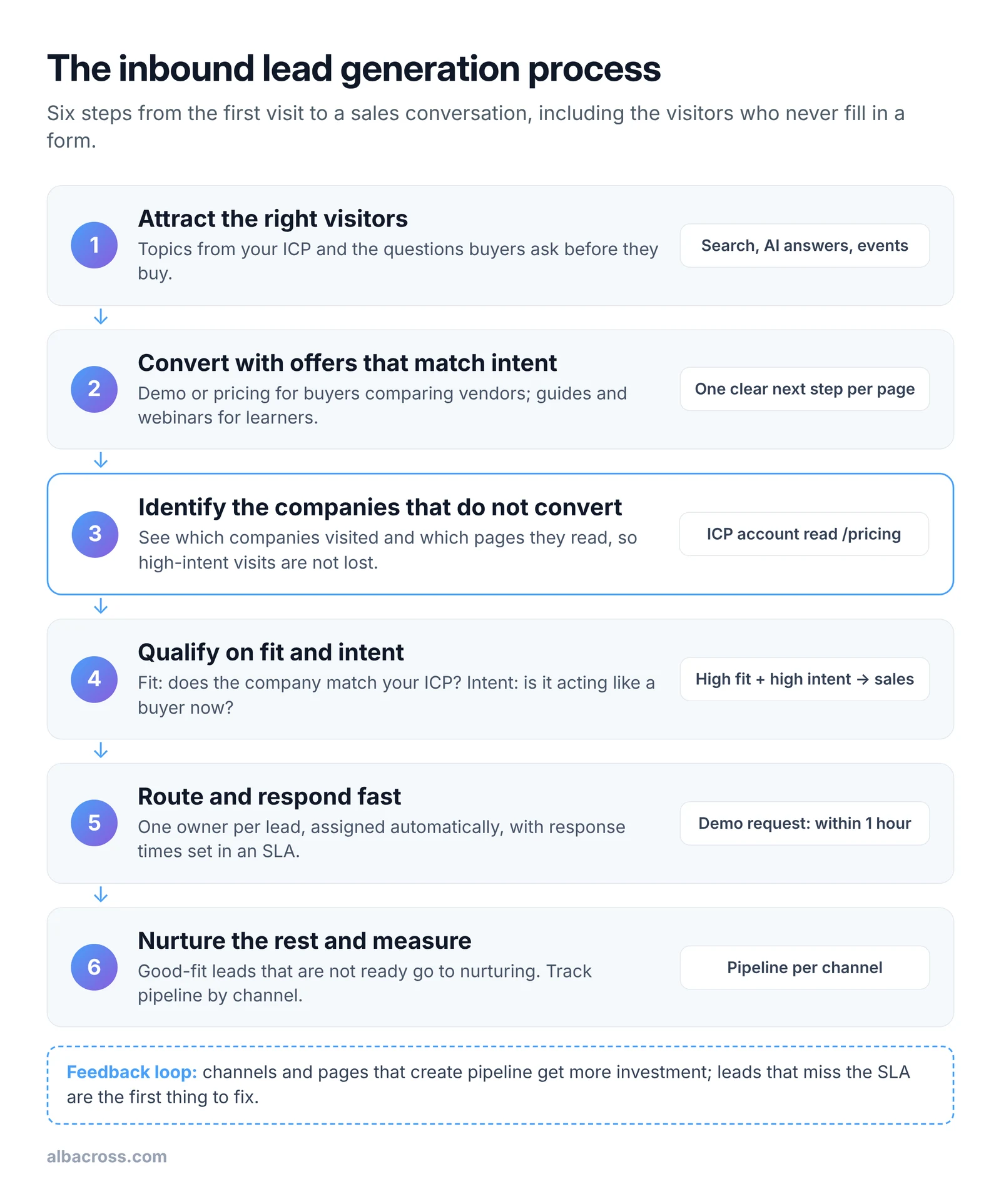
- Attract the right visitors. Pick topics from your ideal customer profile (ICP) and the questions buyers ask before they buy. Traffic from people who will never buy makes your numbers look better and your pipeline no bigger.
- Convert with offers that match intent. A demo or pricing request fits someone comparing vendors. A template, checklist or webinar fits someone still learning. Give each page one clear next step and keep forms short.
- Identify the companies that do not convert. Most visitors leave without filling in a form. Website visitor identification, based on methods such as reverse IP lookup, shows which companies visited and which pages they read, so high-intent visits are not lost.
- Qualify on fit and intent. Fit asks whether the company matches your ICP. Intent asks whether they are acting like a buyer now. Score both so sales starts with the leads that have both. Our lead qualification guide covers frameworks and a scoring model.
- Route and respond fast. Send each lead to one owner automatically and agree on response times (see the SLA template below). A good lead that waits two days in a shared inbox is often a lost lead.
- Nurture the rest and measure. Leads that fit but are not ready go into lead nurturing. Track results by channel and page, and put more into what produces pipeline, not just leads.
Worked Example: How Much Traffic Does Your Target Need?
Work back from the number sales needs. The rates below are illustrative, not benchmarks. Use your own from your CRM and analytics.
| Stage | Rate used | Per month |
|---|---|---|
| Sales-qualified leads (target) | 12 | |
| Marketing-qualified leads | 30% become SQLs | 12 ÷ 0.30 = 40 |
| Form leads | 40% become MQLs | 40 ÷ 0.40 = 100 |
| Website visits from your target market | 2% fill in a form | 100 ÷ 0.02 = 5,000 |
Two things stand out. First, each rate multiplies the others: raising the visit-to-form rate from 2% to 3% cuts the traffic you need from 5,000 to about 3,333 visits, which can be easier than finding 1,667 more visits. Second, at a 2% conversion rate, 4,900 of those 5,000 visits leave without a form. If you can see which companies made those visits, you get a second list to work: accounts that match your ICP and read high-intent pages, such as pricing or a product page, without converting. Sales or marketing can follow up with them, using the pages they read as context.
In this example, if 50 such accounts show up in a month and 10% turn into a sales conversation, that is 5 extra conversations from traffic you already have. Again, these numbers are illustrative; measure your own over a few months before you plan around them.
Speed to Lead: An SLA Template
How fast you respond is one of the few parts of inbound that is fully under your control. In their Harvard Business Review article on online sales leads, James Oldroyd, Kristina McElheran and David Elkington (March 2011) wrote: "Our research shows that most companies are not responding nearly fast enough." The fix is an agreement between marketing and sales, a service level agreement (SLA), that sets who follows up on what and how fast. Here is a starting point to adapt:
| Lead type | Owner | First response | Follow-up |
|---|---|---|---|
| Demo or pricing request | SDR or account executive | Within 1 business hour | Call and email the same day, then 3 more touches over 7 days |
| Contact form, sales question | SDR | Within 4 business hours | Answer the question, then offer a call |
| ICP account on pricing or product pages, no form | SDR or account owner | Within 1 business day | Email or LinkedIn message to the likely buyer, about the problem those pages cover |
| Webinar attendee from an ICP account | SDR | Within 2 business days | Follow up on the webinar topic and offer a related resource or call |
| Content download, good fit, low intent | Marketing | Automated email the same day | Nurture sequence; hand to sales when intent rises |
| Poor fit (outside ICP) | Marketing | Automated email | Newsletter only; no sales follow-up |
Review the SLA every month: how many leads of each type came in, what share was followed up within the agreed time, and how many became opportunities. Leads that miss the SLA are the first thing to fix.
How to Qualify Inbound Leads
A form fill tells you someone is interested. It does not tell you whether they can buy. Check two things before sales spends time:
- Fit: industry, company size, location, tech stack and the person's role, compared with your ICP. A student downloading an ebook and a head of sales at a target account are not the same lead.
- Intent: what they did. A demo request, repeat visits to pricing, several people from the same company on your site, or reading comparison pages all point to a buying process.
A simple rule works well to start: high fit and high intent go to sales now, high fit and low intent go to nurture, and low fit gets an automated response. As you get more data, turn this into a points-based score. The lead qualification guide has a worked scoring model and compares BANT, CHAMP and MEDDIC.
Metrics to Track
| Metric | How to calculate it | What it tells you |
|---|---|---|
| Visit-to-lead rate | Form leads ÷ visits, per page or channel | Whether the offer matches what visitors came for |
| Lead-to-MQL rate | MQLs ÷ leads | Whether you attract companies that fit your ICP |
| MQL-to-SQL rate | SQLs ÷ MQLs | Whether marketing and sales agree on what a good lead is |
| Speed to lead | Time from form fill to first human response | Whether the SLA is being met |
| Pipeline per channel | Opportunity value created, by first or most recent channel | Which channels deserve more budget |
| Identified high-intent accounts | ICP companies that visited key pages without a form | How much demand your forms are missing |
Common Mistakes
- Measuring leads instead of pipeline. A gated ebook can produce hundreds of leads and no opportunities. Judge channels by the opportunities and revenue they create.
- Slow or shared follow-up. A lead sent to a shared inbox with no owner often waits days. Route each lead to one person automatically.
- Only working form fills. If most visitors never fill in a form, a process that only handles forms ignores most of your demand.
- Long forms on every page. Ask only for what you need to route the lead. You can enrich company details later.
- Content for everyone. Broad topics bring traffic from people who will never buy. Write for the problems your ICP has.
- No agreement with sales. Without a shared MQL definition and an SLA, marketing counts leads that sales ignores.
How Albacross Fits Into Inbound
Albacross identifies the companies visiting your site, so you can see the industry, size and location of accounts that have not filled in a form. That covers step 3 of the process above: the visits that would otherwise leave no trace. Albacross Signal combines behavior, firmographics, CRM history and third-party intent into a single priority score, and can push high-intent accounts that match your ICP to your CRM, which helps with qualifying and routing in steps 4 and 5.
See which companies visit your website with Albacross.
Frequently Asked Questions
What is inbound lead generation?
Inbound lead generation is the process of attracting potential buyers to you, through search, content, AI answers, events, social media and referrals, and turning their interest into leads that sales can follow up. The buyer makes the first move, for example by filling in a form, booking a demo or signing up for a webinar.
What is the difference between inbound and outbound lead generation?
In inbound, the buyer finds you and starts the conversation. In outbound, your team contacts buyers first by email, phone, LinkedIn or targeted ads. Inbound buyers are usually further into their research, while outbound gives you more control over which companies you reach. Many B2B teams use both.
What is an inbound lead?
An inbound lead is a person or company that contacted you or shared their details after finding you on their own, for example by requesting a demo, downloading a guide or registering for an event. Many teams also treat identified companies that read high-intent pages, such as pricing, as inbound accounts to follow up, even without a form.
How do you qualify an inbound lead?
Check fit and intent. Fit is whether the company and the person match your ideal customer profile. Intent is whether they are acting like a buyer, for example by requesting a demo or visiting pricing several times. Leads with both go to sales first; leads with fit but low intent go into nurturing.
How fast should you respond to an inbound lead?
As fast as you can while the person is still engaged. A practical starting target is to respond to demo and pricing requests within an hour during business hours, and to other sales questions the same day. Set the targets in an SLA between marketing and sales, and check every month how often you meet them.
Is inbound lead generation better than outbound?
Neither is better in every case. Inbound tends to bring buyers who are further along and keeps producing leads without a cost per contact once it is built, but it takes months to build and gives you less control over who arrives. Outbound is faster to start and lets you choose accounts, but buyers are colder. The right mix depends on your market, deal size and how much search demand exists for your problem.
Further Reading

Marcus Svensson
Head of Growth

 Overview only the features needed for your use case
- Show how to adapt it to your customer qualification process


