

Outbound lead generation is when your team contacts potential buyers first, by cold email, phone, LinkedIn or ads aimed at named accounts, instead of waiting for them to find you. It works when three things are true: the list only holds companies that fit your ideal customer profile, the accounts with a reason to talk now are contacted first, and every message is about one problem the reader has. This guide covers how outbound compares with inbound, the six-step process, the math for working out how many accounts you need to hit a meeting target, a sample sequence, the email rules in the US, UK and EU, and the numbers to track.
Outbound vs Inbound Lead Generation
Inbound brings buyers to you through search, content, events and referrals. Outbound starts the conversation from your side. Most B2B companies run both, and the two work better together: inbound signals, such as which companies visit your pricing page, tell outbound who to contact first. For the wider picture, see what lead generation is and how it works.
| Outbound | Inbound | |
|---|---|---|
| Who starts | You contact the buyer | The buyer contacts you |
| Control over who you reach | High: you choose the accounts | Low: whoever finds you |
| Speed to first meetings | Days to weeks | Months for content and SEO |
| Buyer readiness | Mostly not yet looking | Already researching |
| Main cost | People's time, data and tools, per account contacted | Content and channels, built up over time |
| Main risks | Low reply rates, spam complaints, legal rules on unsolicited email | Slow to build, less control over lead quality |
Outbound Channels
- Cold email: the cheapest channel per contact and the easiest to test, but the most affected by spam filters and email law (see the rules section below).
- Phone: slower per contact, but a conversation gives you more information than a reply. It needs verified direct numbers, which cost more than emails.
- LinkedIn: connection requests, messages and engagement with a prospect's posts. Useful for reaching people whose email you cannot verify, and for being recognized before a call.
- Account-targeted ads: LinkedIn and display ads shown only to your target accounts, so the name is familiar when the email arrives.
- Direct mail and events: higher cost per contact, usually kept for the largest accounts in an account-based program.
Most teams combine email with one or two of the others in a single sequence, so each touch supports the next.
The Outbound Lead Generation Process
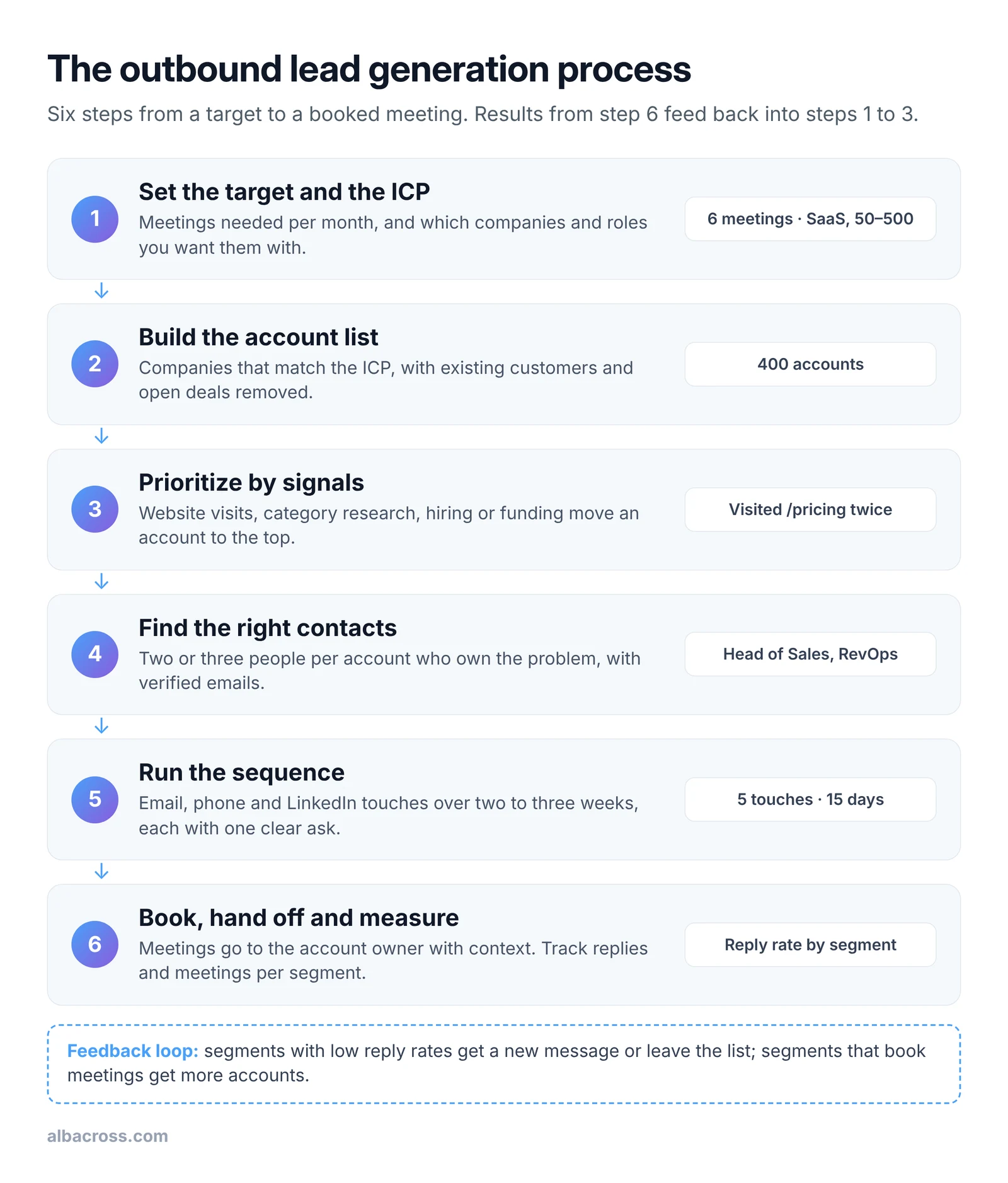
- Set the target and the ICP. Decide how many qualified meetings you need per month and who they should be with: industry, company size, region and the roles that own the problem you solve. Our guide to building an ideal customer profile walks through this, and firmographic data is what you filter on.
- Build the account list. Pull every company that matches the ICP, then remove existing customers, open opportunities and anyone who has opted out before. See how to build a target account list.
- Prioritize by signals. Put the accounts with a reason to talk now at the top: companies visiting your website, researching your category, hiring for the team you sell to, or changing leadership. Our guide to B2B buying signals lists the ones worth acting on.
- Find the right contacts. Two or three people per account who feel the problem and can act on it. Verify emails before sending: bounces hurt your sender reputation. Data enrichment fills in the missing fields.
- Run the sequence. A planned set of touches across channels over two to three weeks, each with one clear ask. A sample is below.
- Book, hand off and measure. Send each meeting to the account owner with the context: why the account was chosen, what was said and what signal triggered the outreach. Then track results per segment and feed them back into steps 1 to 3.
Worked Example: How Many Accounts Do You Need?
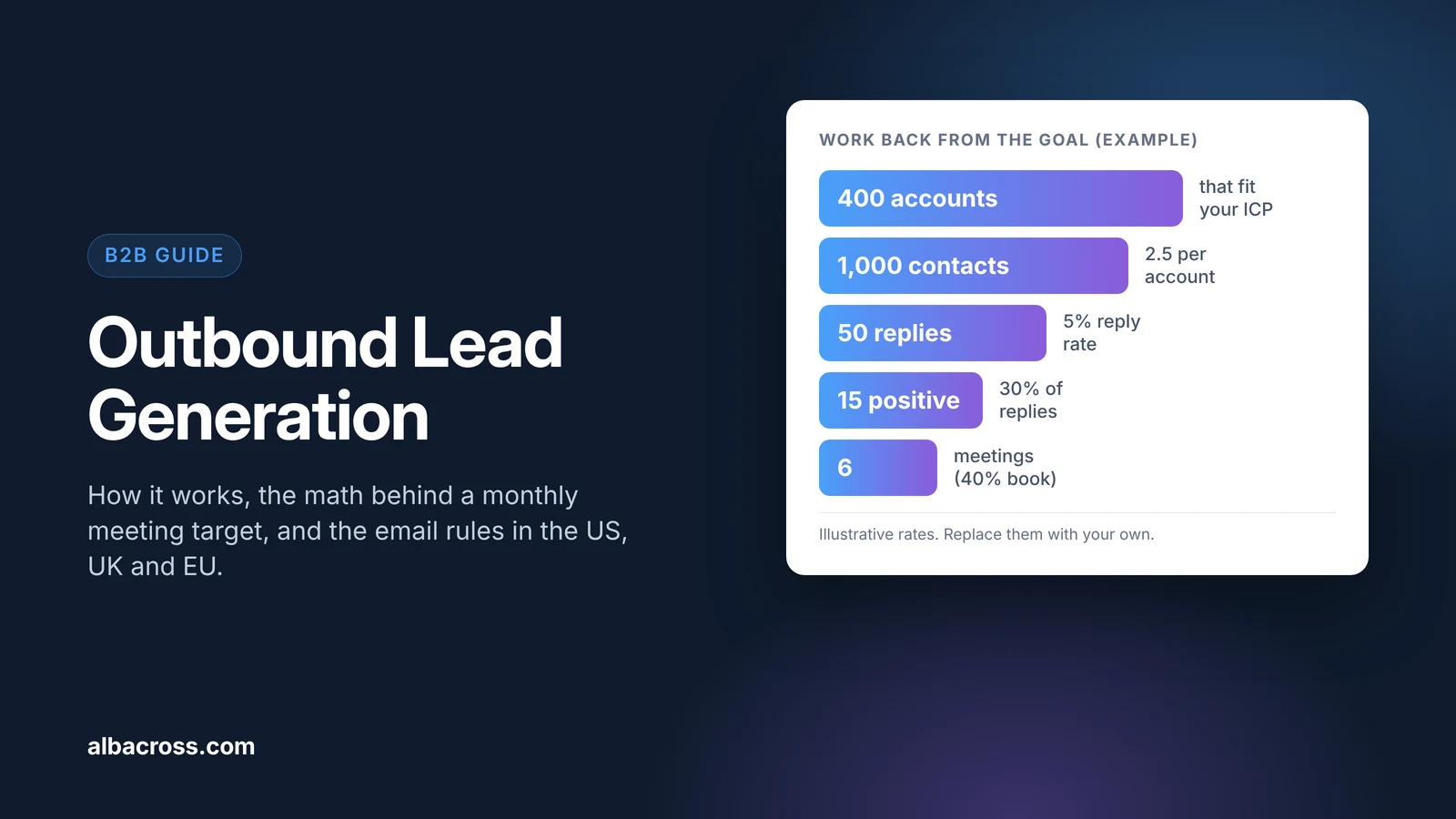
Outbound is a funnel, so you can work backwards from the meetings you need. The rates below are illustrative assumptions, not benchmarks. Reply and booking rates vary widely by market, offer and list quality, so replace them with numbers from your own last campaign.
Goal: 6 qualified meetings per month.
| Step | Assumption | Calculation | Needed |
|---|---|---|---|
| Meetings | Target | Goal | 6 |
| Positive replies | 40% of positive replies book a meeting | 6 ÷ 0.40 | 15 |
| All replies | 30% of replies are positive | 15 ÷ 0.30 | 50 |
| People contacted | 5% of people reply over the full sequence | 50 ÷ 0.05 | 1,000 |
| Accounts | 2.5 contacts per account | 1,000 ÷ 2.5 | 400 |
So under these assumptions you need about 400 fresh, ICP-fit accounts a month. Two things follow from the math:
- The reply rate moves everything. If the same team reached a 7.5% reply rate on a better-targeted list, the need falls to about 667 people and 267 accounts for the same 6 meetings. That is why list quality and timing matter more than sending volume.
- Your market size is a hard limit. If your ICP only contains 2,000 companies, 400 accounts a month uses up the market in five months. Then you need a wider ICP, a longer gap before re-contacting accounts, or a higher reply rate, not more emails.
Run the same calculation for each segment (for example by industry or company size). Segments rarely convert at the same rate, and the averages hide where meetings actually come from.
A Sample Five-Touch Sequence
This is a starting structure, not a rule. Change the timing and channels to fit how your buyers work.
| Day | Channel | What to send |
|---|---|---|
| 1 | The problem, why you are writing to this company now, and one question | |
| 3 | A connection request without a pitch, or a comment on a recent post | |
| 5 | Phone, then email | A short call; if there is no answer, a two-line follow-up that adds one new fact |
| 9 | A useful resource: a short teardown, benchmark from your own customers, or a relevant guide | |
| 15 | A short close: ask whether it is a priority this quarter, and offer to stop writing |
A first email in this structure could read:
Subject: Carrier rollout at Northwind
Hi Anna, I saw Northwind is hiring three dispatchers in Hamburg, which usually means more carriers to coordinate. When logistics teams your size add carriers, the question we hear most is how long it takes to get tracking working across all of them. Is that on your list this quarter, or is it someone else's project?
It names a specific, public reason for writing, it is about the reader's problem rather than your product, and it asks one easy question. Use private signals, such as website visits, to decide who to contact and when, rather than quoting them back to the prospect.
Email Rules and Deliverability
Cold email is regulated, and the rules differ by country. The table summarizes the main points from the primary sources. It is not legal advice; check the rules for each market you send to.
| Where | What the source says |
|---|---|
| US (CAN-SPAM) | The FTC says "the law makes no exception for business-to-business email." Messages need accurate headers and subject lines, a clear disclosure that the message is an ad, a valid physical postal address and a working opt-out, and opt-outs must be honored within 10 business days. (FTC compliance guide) |
| UK (PECR and UK GDPR) | The ICO says the PECR email marketing rule "does not apply to corporate subscribers", but sole traders and some partnerships count as individuals and need consent or the soft opt-in. You must not hide your identity and must give an address to opt out, and UK GDPR still applies when the email address identifies a named person. (ICO B2B marketing guidance; the ICO notes this guidance is under review after the Data (Use and Access) Act.) |
| EU (GDPR) | Recital 47 states that processing personal data for direct marketing "may be regarded as carried out for a legitimate interest", provided the person's interests and rights do not override yours, so you need to weigh the two. Under Article 21, a person can object at any time, after which their data "shall no longer be processed" for marketing. National email marketing laws also apply and differ by country. (Recital 47, Article 21) |
| Gmail (all senders) | Set up SPF or DKIM for your sending domain and keep the spam rate reported in Postmaster Tools below 0.3%. Google's guidance on spam rates recommends staying below 0.10%. (Gmail sender guidelines) |
| Gmail (5,000+ messages a day to personal accounts) | SPF, DKIM and DMARC are all required, and marketing messages must support one-click unsubscribe and show a clearly visible unsubscribe link. (Gmail sender guidelines) |
In practice: send from a domain with SPF, DKIM and DMARC set up, verify addresses before sending, keep a suppression list that every tool checks, include a clear way to opt out, and send less to segments that produce complaints.
Metrics to Track
| Metric | How to calculate it | What a drop usually means |
|---|---|---|
| Bounce rate | Bounced ÷ sent | Old or unverified contact data |
| Reply rate | People who replied ÷ people contacted | Wrong list, wrong timing or a weak first message |
| Positive reply rate | Interested replies ÷ all replies | The message reaches people, but the offer does not fit |
| Meeting rate | Meetings booked ÷ positive replies | Slow follow-up or too much friction to book |
| Meeting-to-opportunity rate | Qualified opportunities ÷ meetings held | Meetings with people who cannot buy, or loose qualification |
| Spam complaint rate | From Gmail Postmaster Tools | Too much volume, poor targeting or a hard-to-find opt-out |
Track every metric per segment and per sequence, not just in total. The aim is to find the segments that book meetings and give them more accounts.
Common Mistakes
- Starting with volume. Sending more to a poor list raises complaints and damages the domain you also use for customer email.
- One message for everyone. A CFO and a sales ops lead at the same company have different problems. Write per role and segment.
- No reason for "why now". Without a signal, the email reads as random. Lead with what made you choose this account.
- Ignoring opt-outs across tools. An opt-out in one tool that is not synced to the others is still a breach of the rules above.
- Judging too early. Read results after the full sequence has run on enough contacts per segment, not after the first email.
- Weak handoff. A meeting booked by an SDR and passed on without context often has to start from scratch.
How Albacross Fits Into Outbound
Albacross identifies the companies visiting your site, so you can see the industry, size and location of accounts that have not filled in a form, and use those visits as a reason to reach out. Albacross Signal combines behavior, firmographics, CRM history and third-party intent into a single priority score, and can push high-intent accounts that match your ICP to your CRM, which helps with steps 2 and 3 of the process above. For a playbook built on website visits, see the Albacross outbound framework.
See which accounts to contact first with Albacross Signal.
Frequently Asked Questions
What is outbound lead generation?
Outbound lead generation is the process of finding companies that fit your ideal customer profile and contacting the right people there first, by email, phone, LinkedIn or targeted ads, to start a sales conversation. It is the opposite of inbound, where buyers find you.
Is outbound or inbound lead generation better?
Neither is better in general. Outbound gives you control over which accounts you talk to and produces meetings faster, but most of the people you contact are not looking yet. Inbound leads are usually further along but slower to build. Most B2B teams use inbound signals, such as website visits, to decide who to contact in outbound.
How many cold emails should you send per day?
There is no single safe number. Gmail's stricter requirements apply to senders of 5,000 or more messages a day to personal Gmail accounts, but spam complaints matter at any volume. Start small on a properly authenticated domain, watch bounces and complaints, and only increase volume on segments that reply.
Is cold email legal in the UK and EU?
It depends on who you email and where. In the UK, the ICO says the PECR email rule does not apply to corporate subscribers, but sole traders and some partnerships need consent or the soft opt-in, and UK GDPR applies to named individuals. In the EU, GDPR allows direct marketing on legitimate interest in some cases, but national email marketing laws also apply and differ by country. Check each market before sending.
What is a good reply rate for outbound?
Published benchmarks vary too much by market, offer and method to be a reliable target. Measure your own reply rate per segment over a full sequence, use it as your baseline, and compare segments against each other.
How long does outbound take to produce meetings?
Replies arrive during the first sequence, which typically runs for two to three weeks. Give each segment a full sequence on enough contacts before you decide whether it works, and expect to change the list and message a few times in the first months.
Further Reading

Marcus Svensson
Head of Growth

 Overview only the features needed for your use case
- Show how to adapt it to your customer qualification process


