

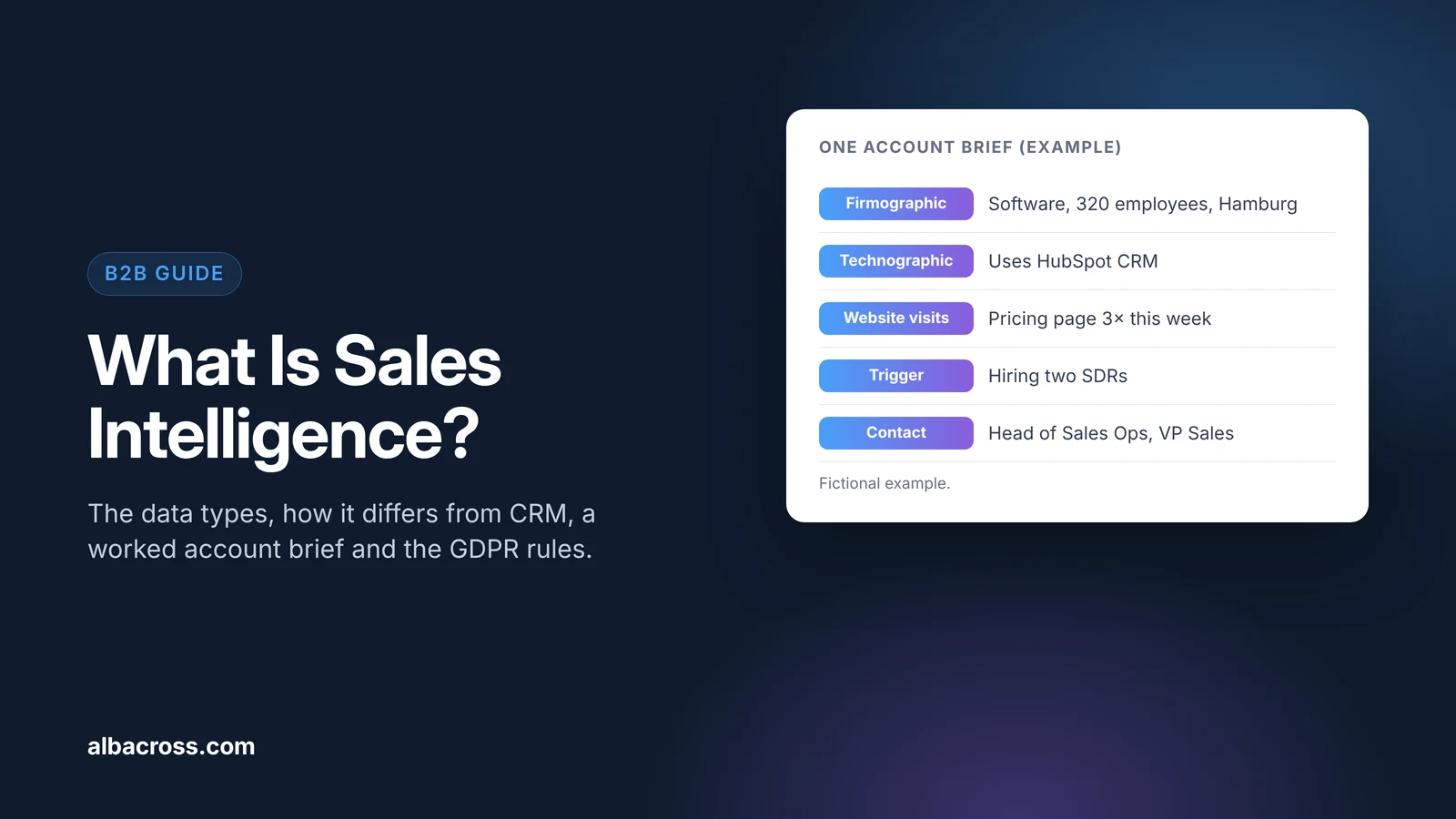
Sales intelligence is the data about companies and buyers, and the tools that collect it, that sales teams use to decide who to contact, when to contact them and what to say. It covers who a company is (firmographics), what it uses (technographics), who works there (contacts), what it is doing now (intent, website visits and trigger events) and what you already know about it (CRM history). This guide explains each data type, how sales intelligence differs from CRM, market intelligence and business intelligence, a worked example of one account brief, the GDPR rules that apply to contact data, and what to check before you buy a tool.
What Sales Intelligence Includes
Most sales intelligence comes down to six types of data. Each one answers a different question for the rep.
| Data type | What it is | Question it answers |
|---|---|---|
| Firmographic | Industry, size, revenue band, location, ownership | Does this company fit our ideal customer profile? |
| Technographic | The software and tools a company uses | Can we integrate, replace or complement what they have? |
| Contact | Names, roles, business emails and phone numbers | Who owns the problem, and how do we reach them? |
| First-party intent | Behavior on your own channels, such as website visits, pricing page views and email clicks | Is this company looking at us right now? |
| Third-party intent | Research activity on other websites, aggregated by topic | Is this company researching our category? |
| Trigger events | Funding, hiring, leadership changes, expansion, acquisitions | Is there a reason for them to act now? |
Your own CRM history (past deals, lost reasons, open opportunities and support tickets) is the seventh source, and it is often the most useful, because no vendor has it. For more on these, see our guides to firmographic data and B2B buying signals.
Sales Intelligence vs CRM, Market Intelligence and Business Intelligence
These terms overlap, and vendors use them loosely. The differences are about scope and who uses the output.
| Term | Focus | Typical user | Example question |
|---|---|---|---|
| Sales intelligence | Individual accounts and buyers you could sell to | SDRs, account executives, RevOps | Which 20 accounts should we call this week, and who at each? |
| CRM | Records of your own customers, prospects and deals | Sales, customer success, management | What stage is this deal at, and who spoke to them last? |
| Market intelligence | Markets, segments, competitors and trends as a whole | Strategy, product marketing | How big is the mid-market logistics segment in the Nordics? |
| Business intelligence | Your own internal data, reported and analyzed | Finance, operations, leadership | What was our win rate by region last quarter? |
| Sales engagement | Running outreach: sequences, calls and email | SDRs and account executives | Who is due a follow-up today? |
In practice, sales intelligence feeds the CRM with better data, and the CRM and sales engagement tools act on it. Business intelligence then measures whether it worked.
How Sales Intelligence Works
Whatever tools you use, sales intelligence follows the same five steps, from raw data to a rep doing something different.
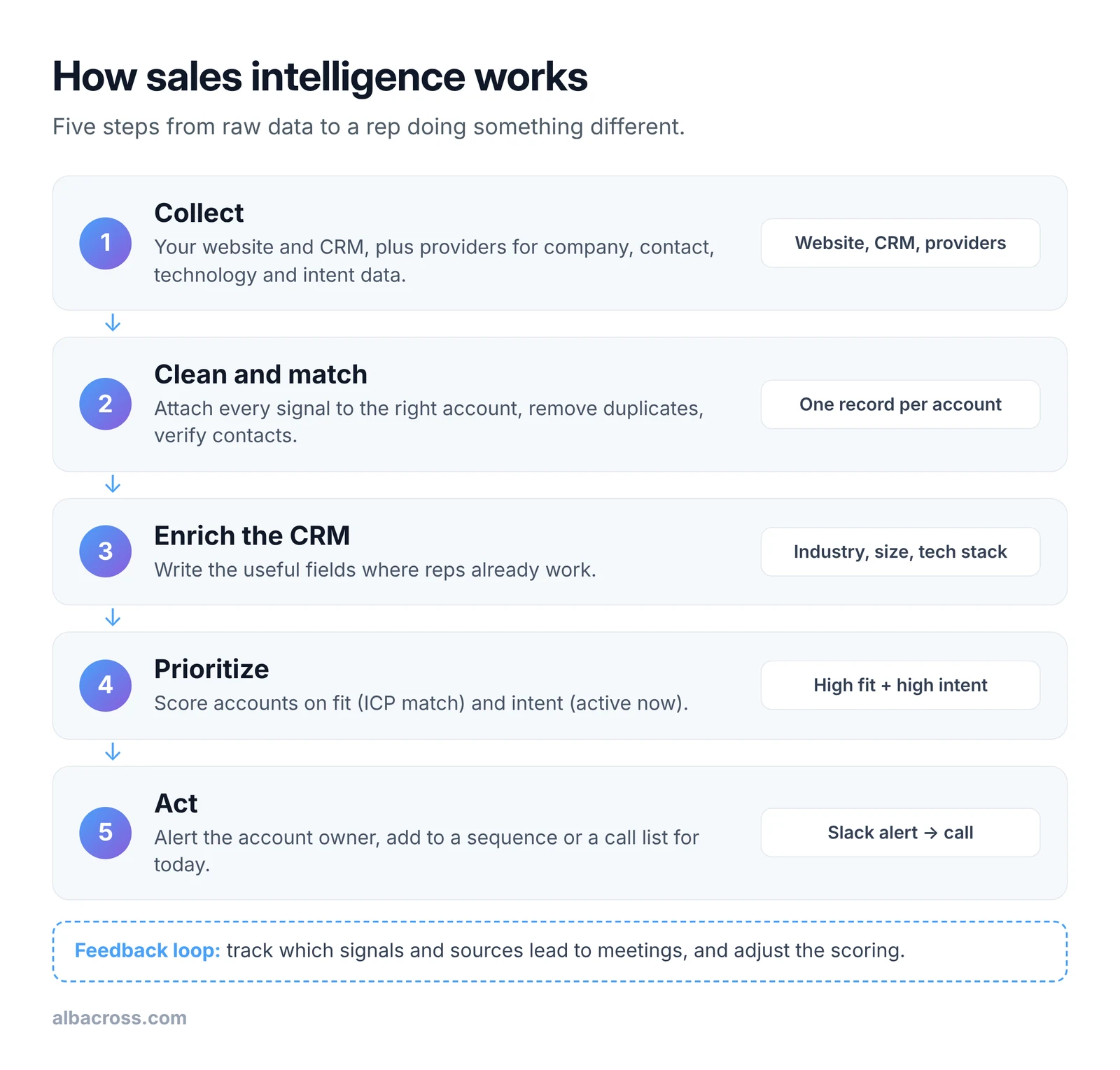
- Collect. Bring in data from your own website and CRM, and from outside providers for firmographics, technographics, contacts and third-party intent.
- Clean and match. Match every signal to the right company record, remove duplicates and verify contact details. A signal attached to the wrong account is worse than no signal.
- Enrich the CRM. Write the useful fields into the CRM, so reps see them where they already work instead of in another tab. Our guide to B2B data enrichment covers how.
- Prioritize. Score accounts on fit (do they match your ICP?) and intent (are they active now?). The lead qualification guide has a scoring model you can adapt.
- Act. Turn the score into an action: an alert to the account owner, a step in a sequence or a call list for the day. Then check which signals led to meetings and adjust the weights.
Worked Example: One Account Brief
Here is what sales intelligence looks like for a single account before a rep reaches out. The company and the details are fictional, but each line uses one of the data types above.
| Data type | What the rep sees | What it changes |
|---|---|---|
| Firmographic | Logistics software, 320 employees, Hamburg, privately owned | Fits the ICP (software, 200 to 1,000 employees, DACH), so it goes on the list |
| Technographic | Uses HubSpot as its CRM | The rep leads with the HubSpot integration |
| First-party intent | Three visits from the company to your pricing page and one to an integration page this week | Moves the account to the top of this week's list |
| Third-party intent | Rising research on topics in your category | Confirms the visits are not a one-off |
| Trigger event | Job posts for two new SDRs | Gives a public reason to write: a growing sales team |
| Contact | Head of Sales Operations and VP Sales, with verified business emails | Two people to contact, each with a message for their role |
| CRM history | Lost deal 14 months ago: "no budget this year" | The rep opens by acknowledging the earlier conversation |
Without this brief, the rep has a company name and a generic email. With it, the rep knows this account is a fit, active now, who to write to, and has a public reason to get in touch (the hiring) plus a past conversation to build on. The website visits decide who to contact and when; the message itself should lead with the public trigger and the problem, not quote the visits back to the prospect. For how to turn this into a sequence, see outbound lead generation.
Where Sales Intelligence Data Comes From
- Your website: visitor identification shows which companies visit and which pages they read. It is first-party data, so it is specific to your product. See how to identify website visitors.
- Your CRM and product: deal history, support tickets and, for product-led companies, product usage.
- Data providers: company databases, contact databases and technographic data, usually licensed.
- Intent data providers: topic-level research activity across many publisher sites. Our guide to using intent data for B2B marketing explains how it is collected.
- Public sources: company websites, press releases, job boards, annual reports and business registers.
Data Accuracy, Decay and GDPR
Sales intelligence is only as good as its data, and B2B data goes out of date as people change jobs and companies grow, merge or move. Two habits help: refresh contact records before each campaign rather than once a year, and track bounce rates and wrong-person replies by data source, so you can see which source is wearing out.
If you sell into the EU or contact people based there, GDPR applies to contact data about named people, even at work. Two parts of the regulation matter most for sales intelligence (this is a summary, not legal advice):
- Accuracy. Article 5(1)(d) requires personal data to be "accurate and, where necessary, kept up to date", with every reasonable step taken to erase or correct inaccurate data without delay. Stale contact data is a compliance problem as well as a deliverability problem.
- Telling people where you got their data. When personal data was not collected from the person themselves, Article 14 requires you, with limited exceptions, to tell them, among other things, "the categories of personal data concerned" and "from which source the personal data originate". The general deadline is a reasonable period after you obtain the data, "at the latest within one month", and if you use the data to contact them, "at the latest at the time of the first communication".
In practice, that means knowing which provider each contact came from, being able to say so in your first email or privacy notice, honoring objections across all your tools, and deleting records you can no longer keep accurate. Ask vendors how they meet these rules for the data they sell you.
How to Choose a Sales Intelligence Tool
Tools differ most in where their data comes from and which regions they cover, so test them on your own accounts rather than comparing feature lists. Questions to ask every vendor:
- Coverage: How many of the accounts on our target list do you have, with the fields we need? Run this test on a sample of a few hundred of your own accounts.
- Accuracy and freshness: How do you verify emails and phone numbers, and how often do you refresh them? What happens to bounced records?
- Regional fit: Is your coverage as good in our markets (for example the Nordics, DACH or the UK) as in the US?
- Signals: Which intent and trigger signals do you provide, and are they first-party, third-party or both?
- Workflow: Does the data reach our CRM and Slack or Teams automatically, or do reps have to open another tool?
- Compliance: How do you meet GDPR Article 14 for the contact data you supply, and how do you handle objections and deletion requests?
- Pricing model: Is it priced per seat, per credit or per record, and what happens when credits run out?
For intent data specifically, see 8 questions to ask before you buy a B2B intent data tool.
Common Mistakes
- Buying data before defining the ICP. Without clear criteria for fit, more data just means a longer list of the wrong companies.
- Leaving data in a separate tool. If reps have to log in somewhere else to see it, most of it will not be used.
- Treating every signal as equal. A pricing page visit from an ICP account means more than a blog visit from a student. Weight signals by fit and by how close they are to buying.
- Never refreshing records. Data that was correct at import goes out of date. Plan refreshes.
- Quoting tracking data in outreach. Use website visits to decide who to contact and when, but lead the message with the buyer's problem or a public trigger.
- Not measuring results. Track which signals and sources lead to meetings and opportunities, and drop the ones that do not.
How Albacross Fits Into Sales Intelligence
Albacross identifies the companies visiting your site, so you can see the industry, size and location of accounts that have not filled in a form. That is the first-party intent layer in the account brief above. Albacross Signal combines behavior, firmographics, CRM history and third-party intent into a single priority score, and can push high-intent accounts that match your ICP to your CRM, which covers the prioritize and act steps of the process.
See which accounts to prioritize with Albacross Signal.
Frequently Asked Questions
What is sales intelligence?
Sales intelligence is the data about companies and buyers, and the tools that collect it, that help sales teams decide who to contact, when and with what message. It typically includes firmographic, technographic, contact, intent and trigger-event data, combined with your own CRM history.
What is an example of sales intelligence?
A rep sees that a company that fits the ideal customer profile visited the pricing page three times this week, is hiring two SDRs and uses a CRM you integrate with. The rep contacts the head of sales operations that day, leading with the integration and the growing team. Each of those facts is sales intelligence.
What is the difference between sales intelligence and CRM?
A CRM stores and manages your own records of customers, prospects and deals. Sales intelligence adds data from outside and from your website, such as company details, contacts and buying signals, usually by enriching the CRM. Most teams use both together.
What is the difference between sales intelligence and market intelligence?
Market intelligence looks at markets, segments and competitors as a whole, to inform strategy. Sales intelligence looks at individual accounts and people you could sell to, to inform what a rep does this week.
Is sales intelligence legal under GDPR?
It can be, but the rules apply to contact data about named people in the EU. You need a lawful basis, data that is accurate and kept up to date (Article 5), and you must tell people where you got their data when you first contact them (Article 14). Check the details with your legal team.
What are sales intelligence tools?
Sales intelligence tools collect and deliver the data above. Some focus on one layer, such as contact data, website visitor identification or intent data; others combine several. Compare them on coverage of your own target accounts, data freshness, regional fit, how the data reaches your CRM and how they handle GDPR.
Further Reading

Marcus Svensson
Head of Growth

 Overview only the features needed for your use case
- Show how to adapt it to your customer qualification process


